Postbaccalaureate training program participants deliver capstone presentations, thank mentors and colleagues
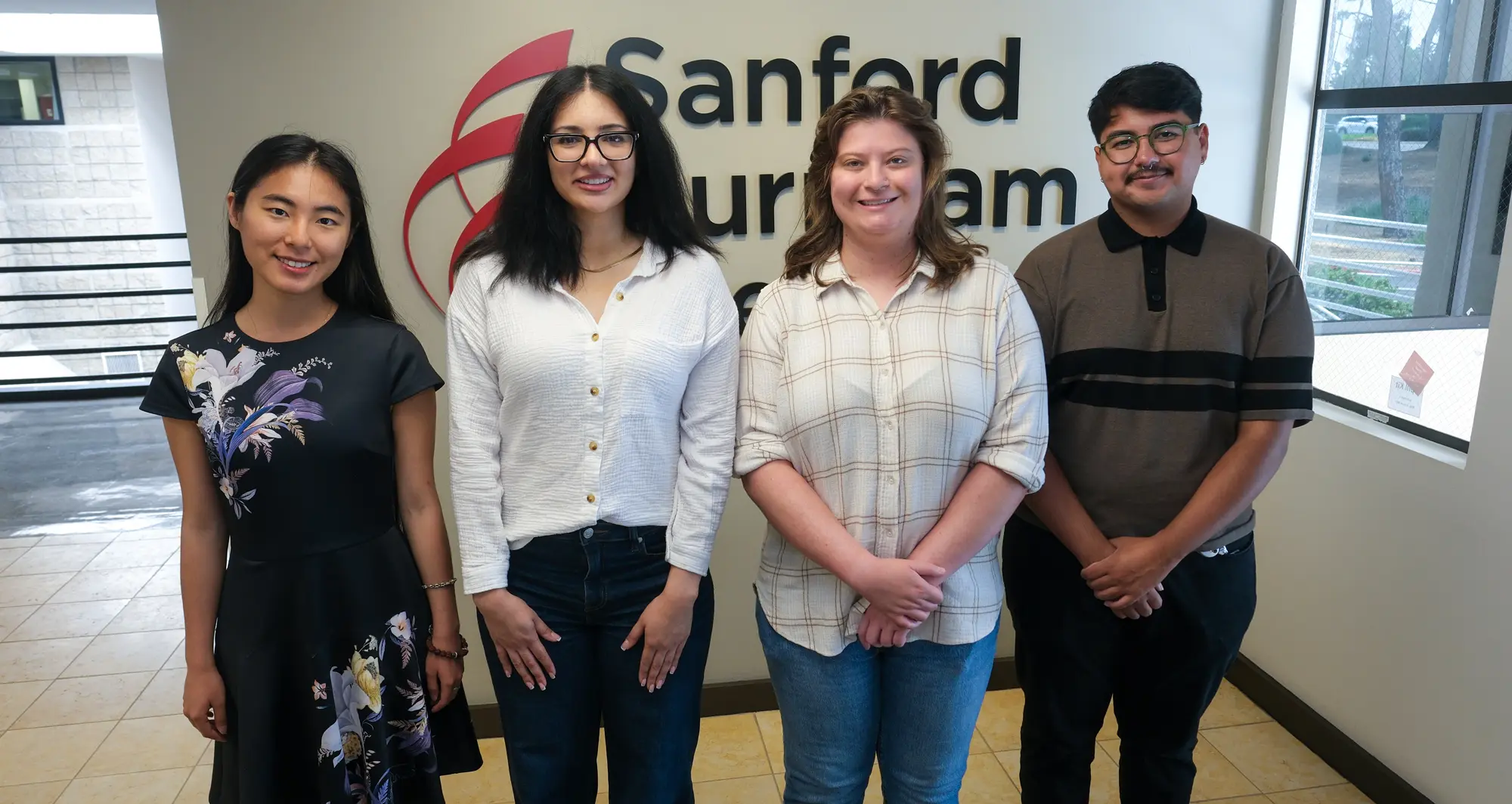
In late June 2026, trainees in the LEAP (Laboratory Experience As Pathway) to a PhD program at Sanford Burnham Prebys Medical Discovery Institute participated in a capstone presentation event. The scholars shared their research findings following a year of work and mentorship in labs throughout the Institute.
The LEAP program was designed to bridge the gap between college graduation and a PhD program. It provides recent graduates with hands-on biomedical research experience, career development opportunities and mentorship to enhance their applications for—and ability to succeed in—highly competitive biomedical PhD programs.
With generous support from the Prebys Foundation, the LEAP program is offered through a collaborative partnership between the Sanford Burnham Prebys NCI-designated Cancer Center and Office of Learning and Development.
“Today we celebrate five of our LEAP program participants who have gained new skills, demonstrated research successes and grown as scientists throughout their journeys here,” said Kevin Yip, PhD, during his introductory remarks.
Following Yip’s welcoming address, the LEAP program mentors introduced the participants and invited them forward for their capstone presentations.
Yun Ma, a trainee in the Feng and Yip labs, discussed her study of proteins that group together in what are called protein complexes to carry out biological functions.
Ma developed a method for comparing data on RNA and proteins to identify priority genes affecting how protein complexes form. These priority genes may help shed new light on how diseases progress and may inform efforts to design new medications.
Her presentation was titled, “Inferring disease-associated changes in protein complex assembly from multimodal data.”
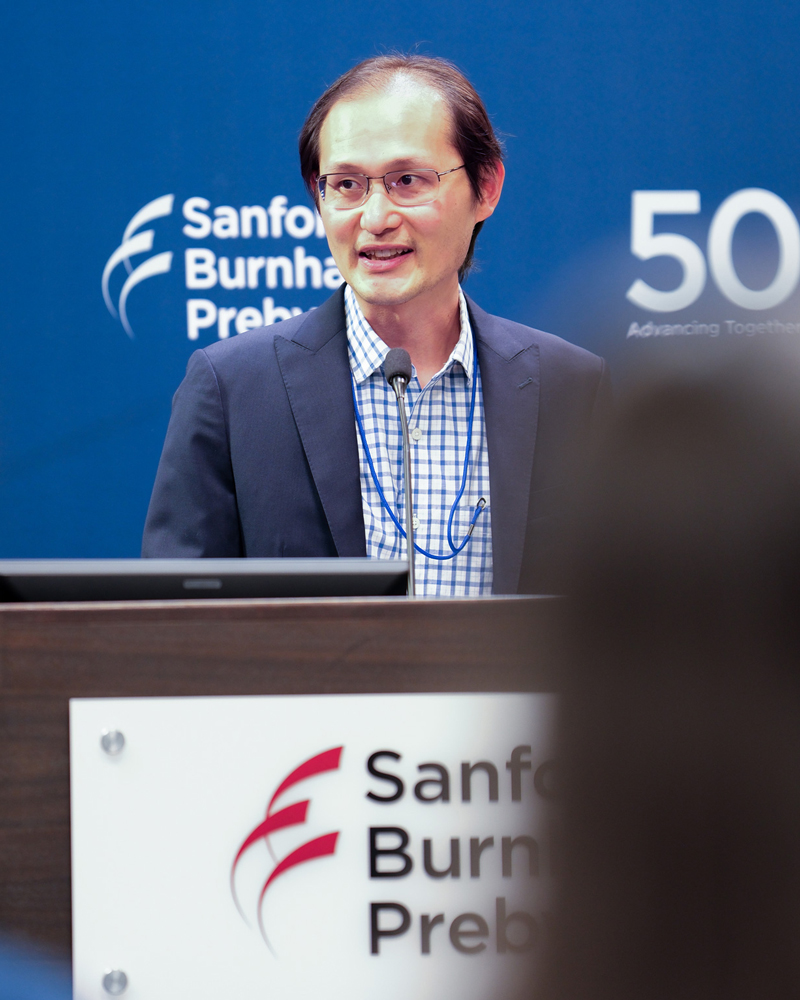
Kevin Yip, PhD, the Andrew and Erna Viterbi Distinguished Chair and director of the Center for Data Science and Artificial Intelligence, provided opening remarks at the event.
Sarina Safavi, a trainee in the Dhar lab, described her work to understand why cardiovascular disease—especially heart failure with preserved ejection fraction—is the leading cause of death among liver disease patients. Safavi developed tools needed to make new liver disease research models to study how the disease affects the heart.
The continuation of this research may lead to the discovery of new drug targets and methods for identifying liver disease patients at greater risk of heart failure to enable earlier treatments.
Her talk was titled, “Mechanistic understanding of MASLD-associated cardiac dysfunction and its reversibility.”
Josue Navarrete, a trainee in the Deshpande and Yip labs, detailed his project focused on small proteins from areas beyond the protein-coding genes that get the most scientific attention. Increasing amounts of evidence supports these microproteins’ biological importance, including in cancer.
Navarette optimized a computational technique for discovering microproteins which enables large-scale studies of thousands of genes. He tested the approach and found microproteins involved in stem cells becoming blood cells and other cells. Studying these microproteins may lead to new diagnostic techniques and potential treatments for blood cancers.
His lecture was titled, “Optimized pipeline enables genome-wide discovery of candidate microproteins in hematopoiesis.” Navarette will be joining the Institute as a doctoral student this fall.
Mahek Shah, a trainee in the Spruck lab, shared her study of a cancer treatment strategy that compels tumor cells to act as if they are infected by a virus. Known as viral mimicry, this therapeutic approach triggers the innate immune system to respond against cancer cells. Shah described drug screening experiments that identified promising novel candidate compounds.
In further tests, these compounds were found to activate viral mimicry, cause an immune response and to be toxic to cancer cells. Continued research may lead to new treatments that can boost the effectiveness of chemotherapy, radiation therapy and targeted therapies.
Her presentation was titled, “Novel compounds targeting histone modifying enzymes induce viral mimicry in breast cancer.”
Isabel Sakowicz, a trainee in the Tharp lab, discussed her research regarding the most common and difficult-to-treat form of ovarian cancer. These tumors can wall themselves off from the immune system with structural collagen proteins that resemble scar tissue.
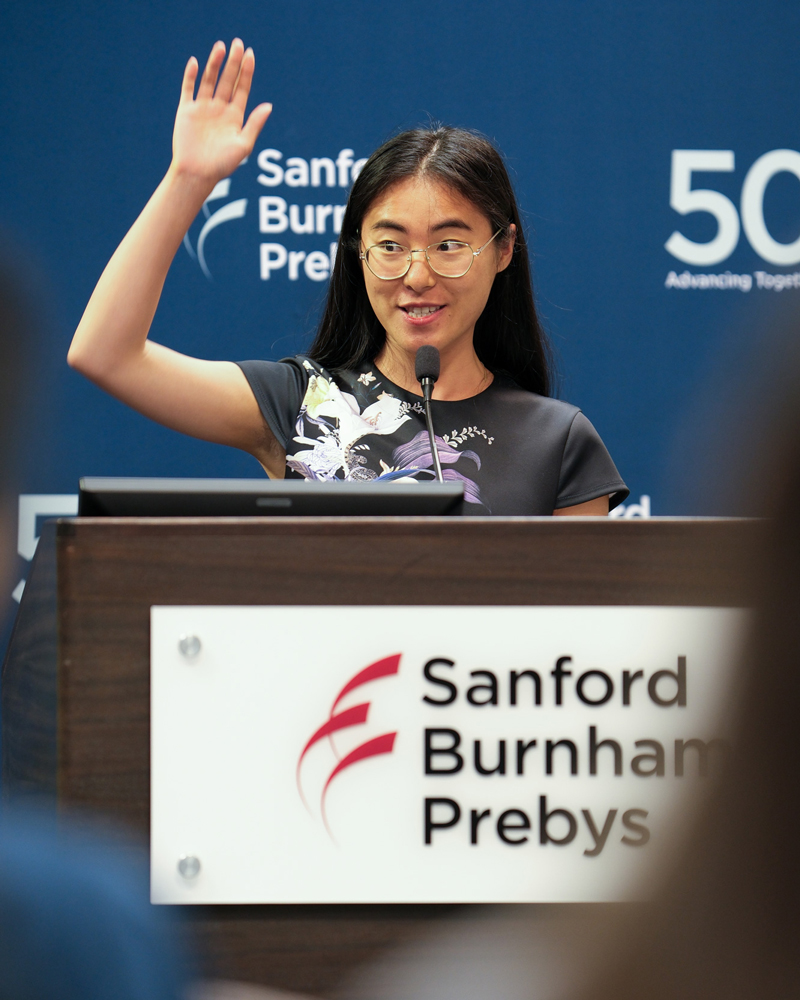
Yun Ma, a trainee in the Feng and Yip labs, discussed her study of proteins that group together in what are called protein complexes to carry out biological functions.
Sakowicz explored how a potential treatment strategy might reduce levels of a form of collagen known to promote ovarian cancer invasiveness and metastasis. Lowering collagen VI levels may break down the barrier around ovarian cancer cells to make other treatments more effective, including immunotherapies.
Her presentation was titled, “FAK protein loss rewires amino acid metabolism in high-grade serous ovarian cancer.” Sakowicz will be joining the Institute as a doctoral student this fall.
In addition to discussing their respective projects, the trainees credited their mentors, fellow lab members and access to avenues for training and advancing as professionals.
“Beyond my scientific achievements, I have enjoyed many career development opportunities, including attending and presenting at workshops, seminars and conferences,” said Ma.
“Everyone in the lab has contributed to a truly supportive and cooperative environment,” said Safavi. “I would also like to thank the LEAP program coordinators for their efforts and making sure we were set up for success.”