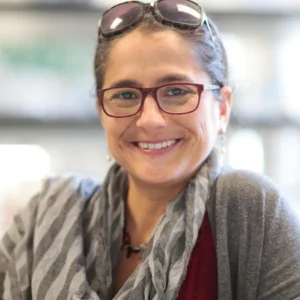
“Sanford Burnham Prebys’s Graduate School of Biomedical Sciences is an interdisciplinary program that offers training in a wide range of biological research areas. The PhD is designed to provide students with a strong foundation of knowledge, enhanced critical thinking, an opportunity to perform high-quality scientific research and develop communication skills that will prepare them for their successful professional career.”
Alessandra Sacco, PhDProfessor and Dean, Graduate School of Biomedical Sciences
Curriculum
Students are required to take five core courses and eight tutorials by the end of their second year.
Core Courses
Molecules to Systems (M2S) An expansive survey course designed for first-year graduate students to obtain broad exposure to a variety of scientific approaches and research in a wide variety of scientific disciplines related to biomedicine. The course is divided into five modules with 20 faculty lecturers. Course Director: Alessandra Sacco, PhD
Introductory Statistics Covers the statistical methods most commonly used in biomedical research. Course Director: Liam Mueller, PhD
Scientific Communication Designed for first-year graduate students to develop and enhance their scientific oral and written communication skills. The course will help students achieve their GSBS program milestones and effectively communicate their research to both scientific and non-scientific audiences. Course Directors: Alessandra Sacco, PhD and Nisha Cavanaugh, PhD
Modern Drug Discovery Techniques (MDDT) Covers the basic principles of a wide range of drug discovery approaches using real examples, including current projects at Sanford Burnham Prebys. Lecturers include faculty and staff involved in drug discovery as well as outside speakers from pharma and biotech. Course Directors: Eric Wang, PhD and Chris Larson, PhD
Computational Biology and Bioinformatics (CBB) Provides an introduction to bioinformatics by introducing students to RNA-seq data analysis, as well as mining genomic databases for –omics data interpretation. Course Director: Kevin Yip, PhD
Tutorials These are a hallmark of the Sanford Burnham Prebys Graduate Program, offering students their choice of small, individualized group sessions led by a faculty expert.
Course Catalog and Student Handbook
The Handbook contains information about admission requirements, curriculum, student expectations and graduation requirements.
The Course Catalog contains descriptions of required courses and tutorials.
Program Learning Outcomes (PLOs)
Sanford Burnham Prebys’ Graduate School of Biomedical Sciences has the following learning outcomes that are aligned with the mission and vision of Sanford Burnham Prebys, and define the program:
PLO 1
Integrate knowledge across biomedical disciplines to develop explanations of biological phenomena
PLO 2
Synthesize the biomedical literature into a research direction
PLO 3
Design a rigorous biomedical experiment to test a hypothesis
PLO 4
Perform appropriate experimental protocols using advanced biomedical research techniques
PLO 5
Analyze biological data using adequate quantitative methods
PLO 6
Communicate scientific findings in an audience-appropriate format
PLO 7
Explain translational applicability of their biomedical research in an audience-appropriate format
A student graduating from GSBS will demonstrate the following:
Strong foundational knowledge in the sciences, for example as measured by passing core courses, the Qualifying Examination, Pre-Thesis and Thesis Defense.
High-quality biomedical research, for example as measured by publication of scientific manuscripts and completion of the written thesis.
Innovative critical thinking, for example as measured by problem solving in the laboratory.
Clear written communication in standard academic genres, for example as measured by annual writing requirements and course assignments.
Excellent oral communication skills, for example as measured by presenting at Data Club and the GSBS Annual Retreat.
Course Learning Outcomes
All courses and tutorials have Course Learning Outcomes (CLO) that align with one or more of the Program Learning Outcomes (PLO). CLOs are listed on each course syllabus. Course syllabi are emailed to students in advance of class. All syllabi can be found in the Graduate School’s Student Access Folders. Faculty and deans assess student mastery of the CLOs through the course evaluation system.
Evidence of Student Learning
Mastery of the PLOs are assessed through coursework, including homework assignments, presentations and exams. Course rubrics are used to determine how well students are achieving the Program Learning Outcomes. The Associate Dean of Curriculum compiles an annual curriculum report that analyzes course outcomes. The Curriculum Committee convenes bi-annually to review the curriculum report and suggest modifications to the curriculum.
We discover and explore the roots of human biology in the context of translational biomedical science, with small classes, focused courses, a low faculty-to-student ratio, individualized tutorials and a highly collaborative environment.
Areas of research vary with program faculty. Please explore our Please explore Our Community webpage for more detailed information regarding the research interests of each faculty member.
The PhD Program is full-time. Most students are unable to take on additional, or even part-time, commitments while completing this program.
All enrolled students in good academic standing receive a stipend. The stipend for the 2026-27 academic year is $53,045.
Stipends are paid bi-monthly in accordance with the Sanford Burnham Prebys payroll schedule. Stipends are paid on the 9th and 24th of the month. Should the 9th and 24th of the month fall on a weekend day, stipend checks will be issued on the Friday before the weekend. If a payday should fall on a holiday, stipend checks will normally be issued the day preceding the holiday.
Yes, students are offered the same health benefits as faculty and staff. The premium cost varies depending on the plan selected and the number of people covered.
No.
No. However, emergency back-up daycare is available to students and employees whose primary daycare is temporarily unavailable.
Please visit the Prospective Students section of the website from more information on applying to our program.
While time-to-degree varies, the average is 4.9 years.
As of Spring 2025, the program has graduated 71 scientists.
87.4%.
You can reach the Graduate School by phone at (858) 646-3100 or by email at GSBS@SBP.edu.
Want to Know More?
If you have questions about the Graduate School of Biomedical Sciences, please contact us.
General Inquiries
Graduate School of Biomedical Sciences Sanford Burnham Prebys 10901 North Torrey Pines Road La Jolla, CA 92037 (858) 646-3100 GSBS@sbp.edu
Admission Inquiries
Admissions Graduate School of Biomedical Sciences Sanford Burnham Prebys 10901 North Torrey Pines Road La Jolla, CA 92037 admissions@sbp.edu