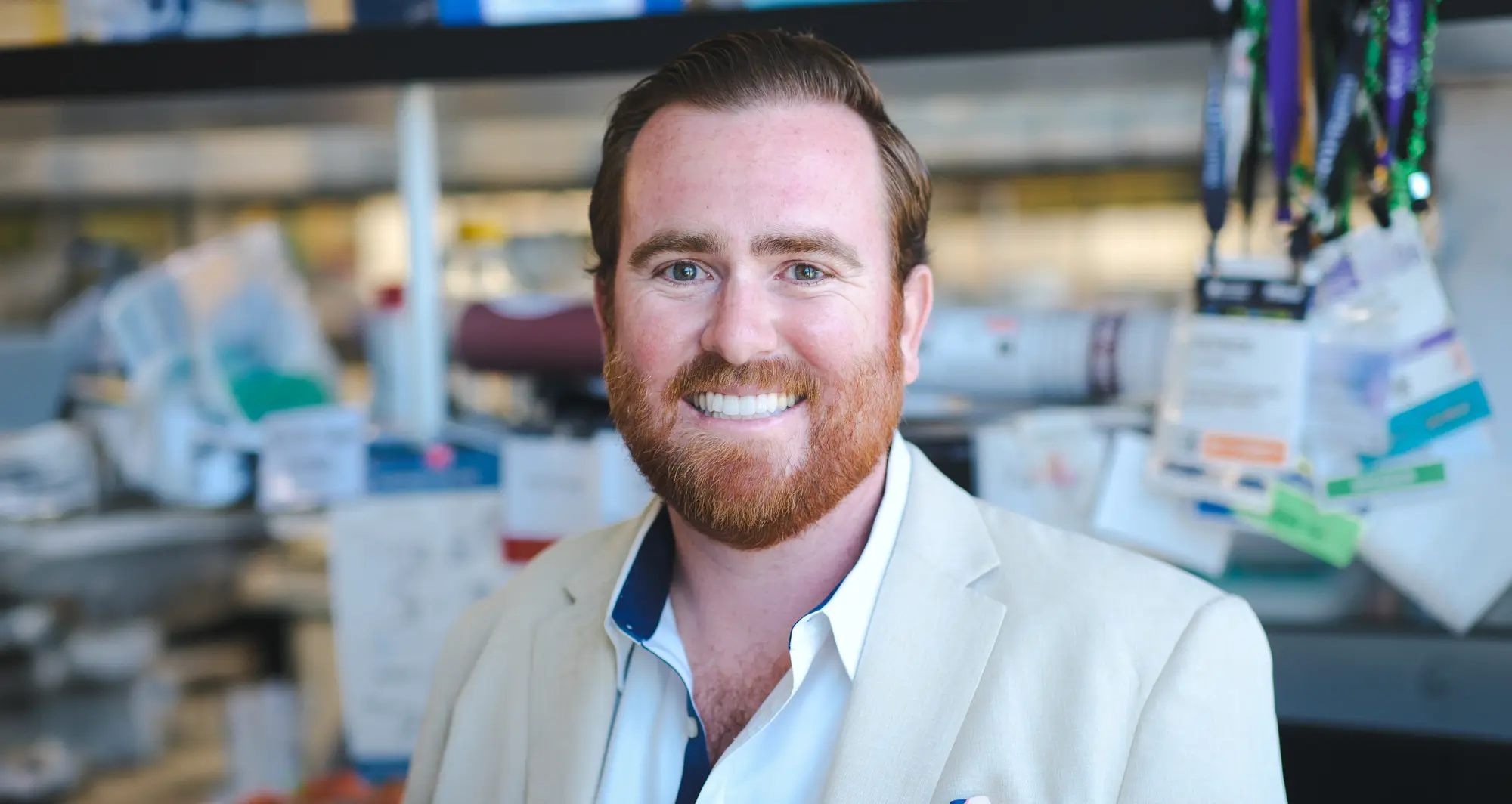
When Patrick Hagan joined Sanford Burnham Prebys as a graduate student, he hoped his research would one day help patients. Today, he is helping research that could translate more than a decade of scientific discovery into a potential new treatment for one of the deadliest forms of cancer.
Hagan, a PhD candidate in the laboratory of Nicholas Cosford, PhD, recently received the top award from the San Diego chapter of Nucleate, a nonprofit organization that helps scientists translate promising discoveries into real-world solutions.
Through the six-month accelerator program, Hagan developed ATG Attack, a venture focused on advancing autophagy inhibitors for pancreatic cancer. The project also received a Biocom Golden Membership at Nucleate San Diego’s Demo Day, recognizing both the scientific promise of the work and its potential to improve outcomes for patients.
“Ultimately, the goal is to improve outcomes for cancer patients,” said Hagan. “That’s why I went to graduate school.”
The project builds on more than 10 years of collaboration between Cosford and director of the Salk Cancer Center, Reuben Shaw, PhD. Together, the teams have been developing compounds that inhibit autophagy, a cellular recycling process that many cancer cells depend on for survival.
“Autophagy is one of the ways cancer cells gain resistance to standard therapies,” Hagan explained. “We’ve reached a point where we believe these compounds have the potential to make it all the way to patients.”
The team’s initial focus is pancreatic cancer, a disease with one of the lowest survival rates among major cancers. Many pancreatic tumors are driven by mutations in the KRAS gene and rely heavily on autophagy. In preclinical studies, the researchers have shown that blocking this process can shrink tumors and enhance the effectiveness of existing treatments.
The experience also reinforced the value of Sanford Burnham Prebys’ translational research environment.
Hagan credits Cosford and colleagues throughout the Institute, including members of the Center for Therapeutics Discovery and its Conrad Prebys Center for Chemical Genomics, with helping shape his approach to drug discovery.
“I’ve been fortunate to work with scientists who are deeply focused on translating discoveries into therapies,” he said. “Our lab operates almost like a small pharmaceutical company. We have chemists creating compounds, biologists testing them and researchers evaluating how they perform in disease models. Everything is focused on moving promising discoveries closer to patients.”
For Hagan, however, the motivation remains personal.
He keeps a Post-it note on his laptop bearing the names of two researchers he knew who died from cancer at a young age. It serves as a daily reminder of why the work matters.
“Research can feel like a series of very small steps,” he said. “But every experiment, every paper and every collaboration has the potential to move the field forward. If something we do helps another scientist, attracts a new partner or ultimately helps a patient, then it’s worth it.”
For Hagan, those small steps are all part of a larger goal: bringing new hope to patients facing pancreatic cancer.