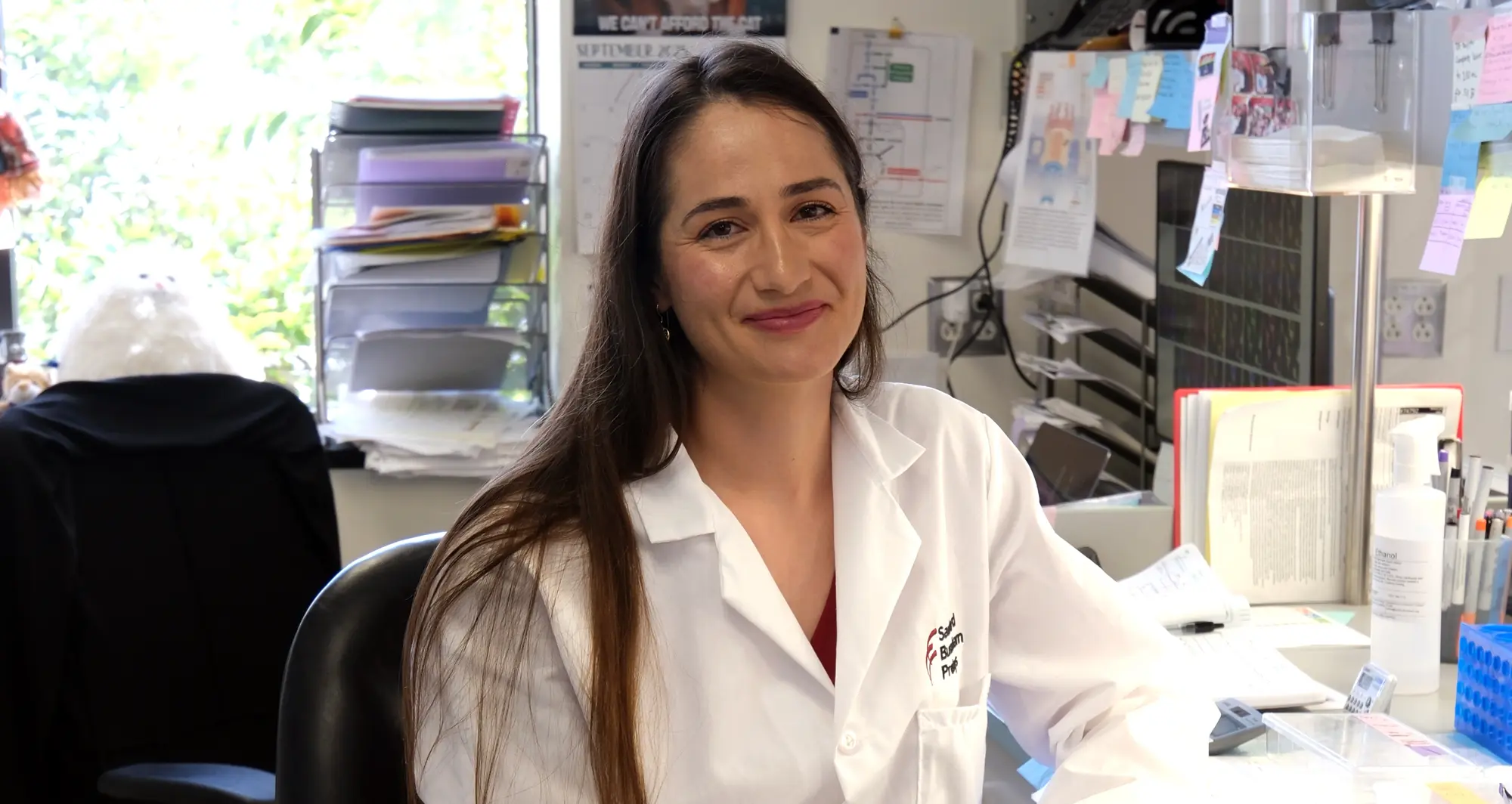
Meet one of our early-career scientists at Sanford Burnham Prebys Medical Discovery Institute: Dana Mamriev, PhD, a postdoctoral researcher in the lab of Maximiliano D’Angelo, PhD. Mamriev studies the gateway between the DNA stored in the cell’s nucleus and the rest of the cell to better understand how changes in this junction contribute to cancer development.
When and how did you become interested in science?
As a teenager, I was very into sports, and I was endlessly fascinated by the human body. I wondered what makes an athlete faster, stronger or better able to perform under pressure.
I started digging a bit into aspects of athletic performance and realized how much depth there is to molecular biology. I began to see that there are different types of muscle cells, how food is broken down to lipids, carbohydrates and amino acids, and that we have different metabolic pathways.
That was the beginning of my interest in science. When I started college, I took a few courses in biology and chemistry. I was immediately hooked. Before long, I knew I wanted to get some hands-on experience in research.
What did you imagine you would be doing professionally, and how did it evolve?
Growing up, I was an athlete on the Israeli national team. I started racing kayaks. Later, I transferred to sailing in a two-person boat called a 470 because it is 470 centimeters long.
I raced in world championships, European championships, world cups and other events. It was fun, and I was quite serious about it until the age of 21 or so.
But even while training and competing, I was equally drawn to science. As an undergraduate, I joined a lab for what I thought would be a one-year research project on cancer and programmed cell death (apoptosis). I loved it so much that I stayed through my undergraduate studies, my master’s degree, and eventually my doctoral training. That experience cemented my commitment to a career in cancer research.
What brought you to the D’Angelo lab at Sanford Burnham Prebys?
What drew me to the D’Angelo lab was its focus on fundamental mechanisms that drive cancer. Nuclear pore complexes are central to so many cellular processes and understanding how they go wrong in cancer has the potential to open new paths for treatment. That combination of basic science and translational impact made the lab the right fit for me.
During my PhD studies, my main project focused on breast cancer. So, I thought it could be a nice transition to study nuclear pore complexes in breast cancer. That ended up becoming my first project at Sanford Burnham Prebys.
What are the key areas of research you focus on?
Our lab studies the nuclear pore complex. It’s basically a grouping of 32 proteins that are embedded in the nuclear envelope dividing the nucleus from the rest of the cell.
It is shaped like a pore and acts as a gate that controls what molecules come in and out of the nucleus where we store our DNA. In addition to this role in transport, the nuclear pore complex has many other functions, including in the cell cycle, gene expression and chromatin organization, and more.
The levels of some of the proteins in the nuclear pore complex are known to be elevated in different types of cancer. I focus on studying these changes in the nuclear pore complex in breast cancer and in lung cancer. I’m trying to understand how these changes are contributing to cancer developing and spreading to other parts of the body.
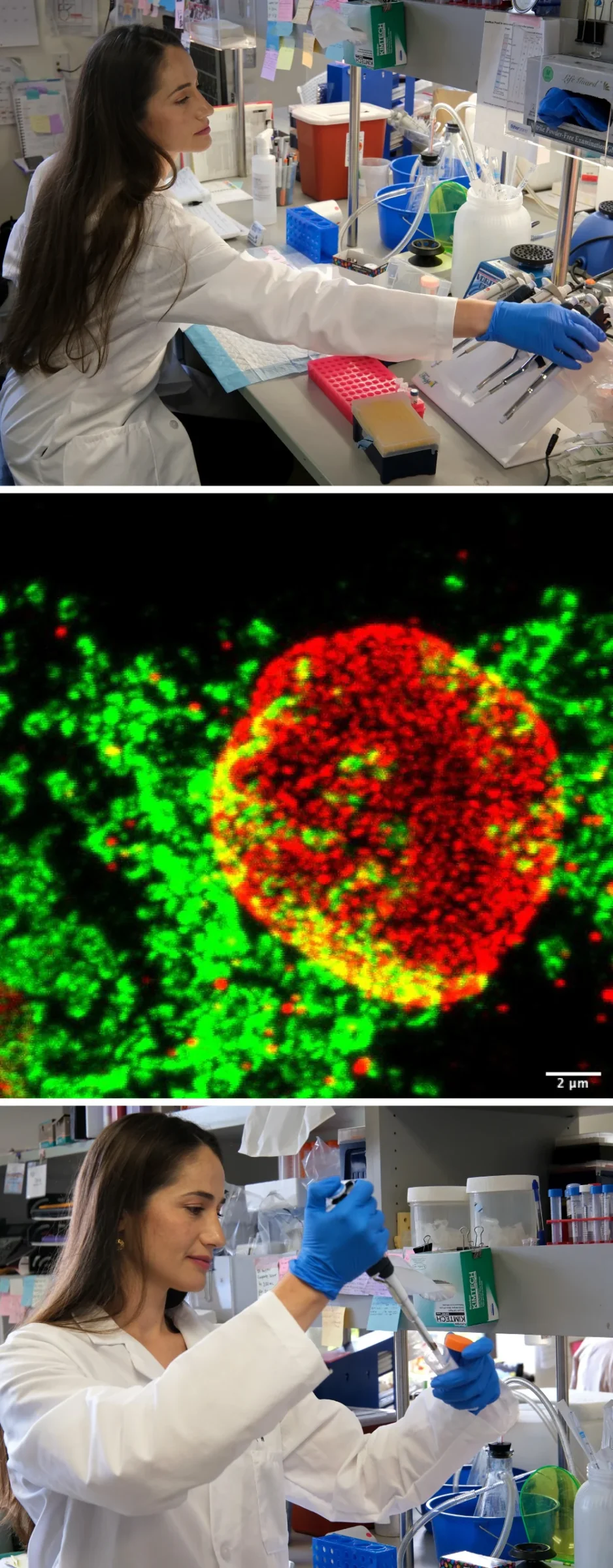
Middle image: Confocal image of an H1437 lung cancer cell showing nuclear pore staining (red) and mitochondria staining (green). Image credit: Dana Mamriev from the D’Angelo lab | Sanford Burnham Prebys.
What motivates you about your research?
I think my main motivation is that I really like what I’m doing It’s the thrill of discovery and the challenge of solving difficult problems. Research often feels like piecing together a complex puzzle. When the data finally come together, it’s deeply rewarding. I especially enjoy the moments when a stubborn experiment finally reveals something new; those breakthroughs make all the effort worthwhile and inspire me to keep pushing forward.
What do you like about working here?
We have a friendly and collaborative environment at Sanford Burnham Prebys. And we have many seminars that people attend and get to know each other, which helps with building collaborations. Also, the core research facilities here are top-tier and enable cutting-edge research.
Then you have San Diego as a hub for research, and especially here in La Jolla with all the great institutes around us. And we have all these biotechnology and pharmaceutical companies nearby as well. It is an outstanding place for scientists.
Have you had an influential mentor?
Throughout my training, I’ve had, and still have, the privilege of working with mentors who are not only accomplished scientists but also generous teachers. Each brought something different: dedication, curiosity, discipline and patience. Their examples have been a constant source of motivation in my career.
What do you enjoy doing when you’re not in the lab?
I took up cycling after moving here and joined the San Diego Bicycle Club. I like to join their weekly rides, and sometimes I bike to work.
I started racing here as a cyclist. I’m familiar with racing in other sports, but racing in cycling was completely new for me. And I found it a bit funny that all the racing experience I have in kayaking and sailing is not helping.
I had to learn new strategies for when to conserve energy and when to go all out. I even got dropped from the peloton of competitors in my first race, so I’m learning the hard way. It just motivates me to better understand the sport, and to keep training and get better.
Postdocs at Sanford Burnham Prebys are pushing the boundaries of science every day through curiosity, collaboration, and innovation. This series highlights their unique journeys, what inspires their work, and the impact they’re making across our labs.