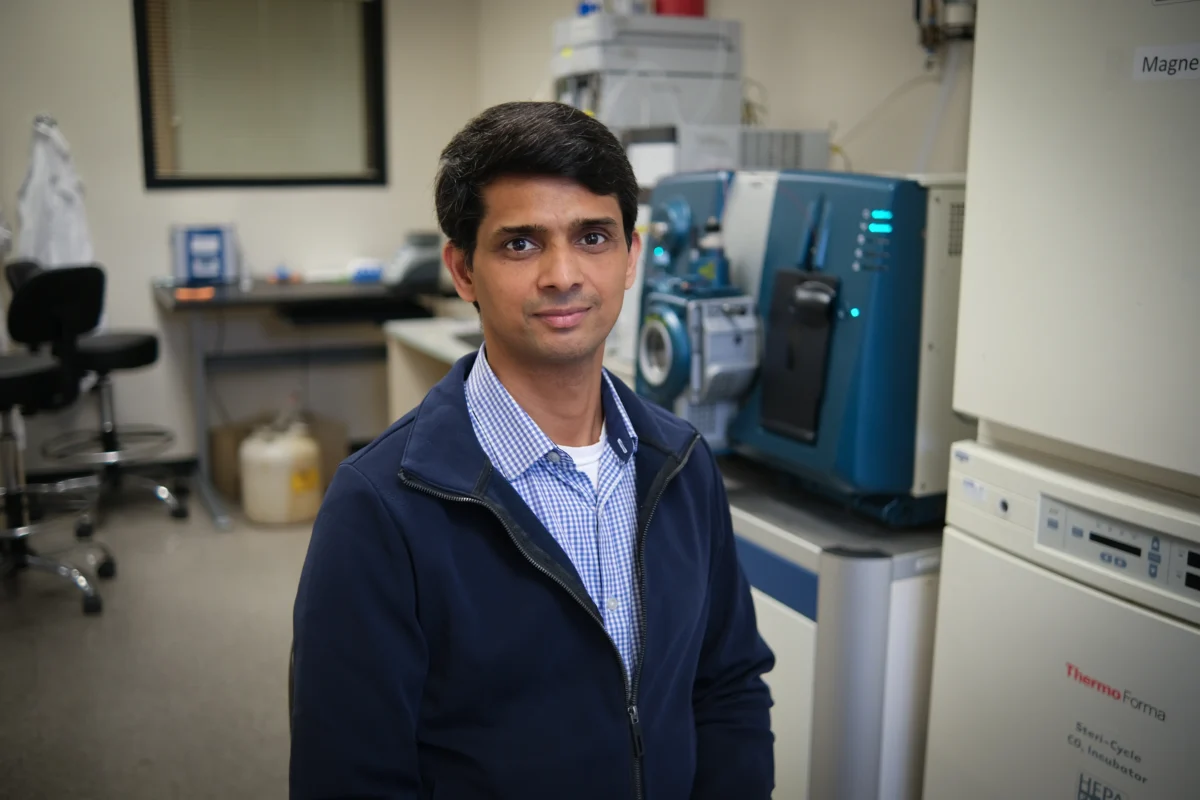
Dr. Raghu Ramachandra is the Director of Automation & Drug Discovery at Sanford Burnham Prebys Center for Therapeutics Discovery. In this role, he oversees two complementary cores at the Conrad Prebys Center for Chemical Genomics: the High-Throughput Screening (HTS) core, which provides the instrumentation, compound libraries, and expertise to conduct large-scale chemical library screens of biological targets, and the Exploratory Pharmacology (ADME/PK) core, which he established to deliver Tier 1 and Tier 2 absorption, distribution, metabolism, and excretion (ADME) and pharmacokinetic (PK) insights on advanced molecules. Together, the cores support internal, collaborative, user-, and facility-driven drug discovery programs across the Center.
The HTS core works closely with the Assay Development and High-Content Screening teams to select and implement the most suitable biochemical or cellular assay for each project, including diverse plate-reader and imaging assays. The Prebys Center maintains collaborations with pharma, biotech, and clinical hospital partners to advance small-molecule therapeutics from assay development through lead optimization to in vivo proof-of-concept.
The Exploratory Pharmacology core complements the Center’s small-molecule discovery platforms by delivering rapid, high-quality assessments of drug-like properties that guide medicinal chemistry decision-making from hit identification through candidate selection, combining comprehensive in vitro ADME profiling, in vivo pharmacokinetics and bioavailability studies, and high-sensitivity LC-MS/MS bioanalysis. He is involved in strategic planning and the coordination of effort between the project teams of the Center and its collaborators to execute projects on schedule and on budget.
Prior to joining Sanford Burnham Prebys, Raghu was the Executive Director and head of Scientific Operations at Galore Tx Pharmaceuticals Private Limited, a drug discovery startup based in Bangalore, India. He led Galore Tx to be a revenue-generating biotech while also heading in vitro, in vivo pharmacology, ADME and in vivo DMPK teams in support of several discovery projects spanning oncology, inflammation, and infectious diseases.
Prior to co-founding Galore Tx, he worked with Aurigene Discovery Technologies Limited (a 100% subsidiary of Dr Reddy’s Laboratories, NYSE: RDY) in Bangalore, India, where he established several in vivo disease models for evaluating efficacy and safety of small molecules and peptides.
Education
Postdoctoral Training: Host-Pathogen Interactions, City of Hope National Medical Center
2008: PhD, Animal and Food Science, West Virginia University
2004: MS in Aquaculture, ICAR-CIFE, Mumbai India
2002: BS in Fisheries, University of Agricultural Sciences, Bangalore (UAS-B)
As Director of Automation & Drug Discovery, Dr. Ramachandra oversees the High-Throughput Screening (HTS) core at the Conrad Prebys Center for Chemical Genomics. Core services include:
- Screening small-molecule compound libraries in 384- or 1536-well formats with various detection technologies (absorbance, fluorescence, luminescence, fluorescence polarization, TR-FRET, AlphaScreen)
- Preparation and handling of compound libraries for high-throughput screening, including automated small-volume dispensing for dose-response testing and cherry-pick confirmation of primary screening hits
- Consultation on high-throughput screening approaches
- Conversion of cell-based and biochemical assays to high-throughput / automation-compatible formats
- Screening data analysis and support for HTS hit follow-up studies
- Guidance on the use of automated instrumentation
The core’s fully integrated automated screening system (HighRes Biosolutions) combines a Staubli TX90XL robotic arm, a 420-plate random-access plate carousel, a 210-plate Liconic incubator for cell-based assays, centrifuges, ViewLux and Pherastar FS multimode plate readers, acoustic liquid handling (Labcyte Echo 655 and 555), plate sealing and peeling, a BioTek EL406 washer, a high-speed pintool, and bulk dispensers. Supporting instrumentation includes Biomek FX liquid handlers (96- and 384-well), an Access Laboratory Workstation for automated compound dispensing, an Agilent plate-processing workstation, PerkinElmer Envision readers, a Kalypsys washer/dispenser system, and a Hamamatsu FDSS7000 rapid-kinetics fluorescence and luminescence reader.
Dr. Ramachandra established and leads the Exploratory Pharmacology (ADME/PK) core at the Center. Core services include:
- Tier 1 in vitro ADME: kinetic and thermodynamic solubility; metabolic stability in liver microsomes, hepatocytes (mouse, rat, human, minipig, dog, and other species on demand), plasma, and formulations
- Tier 2 in vitro ADME: cytochrome P450 inhibition screening; in vitro hERG binding; plasma protein binding and tissue free fraction; and metabolite profiling and identification
- In vivo pharmacokinetics and drug-like properties: IV, IP, PO, SC, and topical pharmacokinetics; oral bioavailability; formulation screening; and tissue/CNS distribution
- Micro-PK studies: serial micro-sampling (~10–15 µL per draw, up to 8 time points over 0–24 hours post-dose) that yields complete PK profiles from as few as 3 mice per arm, minimizing animal use and reducing costs
- High-sensitivity bioanalysis: drug-level quantification by LC-MS/MS with limits of quantification typically below 1 nM and sample volumes as low as 5 µL; metabolite profiling; and bioanalytical support for in vivo PK/PD studies performed outside the Prebys Center
- Extended pharmacology services: analytical method development, allometric scaling and first-in-human dose predictions, AI/ML-driven predictions of key pharmacological properties (brain penetration, CYP lability, P-gp interactions, metabolic pathways) for academic collaborators, and access to vetted vendors for permeability, CYP induction, metabolite identification, genotoxicity, and other specialty assays
The core’s bioanalytical platform is built on state-of-the-art triple quadrupole mass spectrometry (SCIEX API 6500+ QTRAP and API 4000 systems with Shimadzu UHPLC front ends), enabling ultra-sensitive quantification of drug concentrations in plasma and tissue samples. By integrating cutting-edge technology with specialized expertise, the Exploratory Pharmacology group accelerates the identification of viable drug candidates while adhering to ethical and cost-effective practices.
Granted Patent
US11497735B2
Conjoint therapies for immunomodulation. Inventors: Pottayil Govindan N. Sasikumar, Muralidhara Ramachandra, Raghuveer K. Ramachandra, Adam S. Lazorchak, Timothy L. Wyant. US 11,497,735 (granted 2022); US 12,064,418 (granted 2024, continuation).