Rare Diseases Archives - Page 3 of 3 - Sanford Burnham Prebys
Institute News

Diagnosing a rare disease in children

AuthorSusan Gammon
Date

February 6, 2018

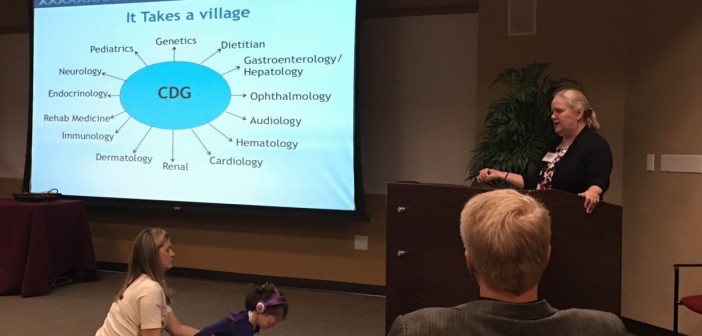
Children born with the rare genetic disorder known as CDG often live for years before they receive a diagnosis.  CDG—which stands for congenital disorders of glycosylation—can cause serious, sometimes fatal, malfunction of different organs and systems in the body, including the nervous system, muscles and intestines. Children with CDG have varying degrees of speech and language difficulty, poor balance, motor control, vision problems, hearing impairments and seizures.

CDGs are difficult to diagnose partly because there are only about 1,800 known cases worldwide. But through global networking and the unwavering determination of researchers and clinicians, new patients are being discovered every year, providing important information to parents to help them better understand what they are dealing with.

Hudson Freeze, PhD, director and professor of the Human Genetics Program at SBP, is a one of the scientific leaders helping diagnose new cases of CDG. Freeze and his colleague, Bobby Ng, recently led an international team charged with diagnosing three unrelated individuals thought to have a new type of CDG—but not confirmed. The work, published in the American Journal of Human Genetics, confirmed that the three had a specific kind of CDG never seen before, adding to the more than 125 existing types of CDGs.

“All CDG disorders are caused by mutations that impair glycosylation—the complex process by which cells build long sugar chains that are attached to proteins called glycoproteins,” explains Freeze. “These sugar chains are crucial for cellular growth, communication and essential cell functions.

“There are many genes involved in proper glycosylation,” says Freeze. “When two parents happen to carry a mutation on the same gene, they end up with a one-in-four chance of passing both mutated copies on their child, and that causes the disorder.”

Increasingly, babies and children with unexplained health problems such as developmental delays and organ dysfunction undergo whole-exome sequencing, a technique that sequences the part of the genome that encodes proteins.

“Exome sequencing is used to find mutations in genes, but sometimes we don’t know if the mutations found actually translate to a genetic condition like CDG,” says Ng.

“Our lab steps in when a suspected mutation is found in one of the many enzymes involved in glycosylation,” says Ng. “We perform biochemical tests to confirm that the mutation impairs the glycosylation process, helping families narrow in on a CDG diagnosis.”

“The three patients in the current study are the only confirmed cases of the FUT8-CDG type in the world,” says Freeze. “These very rare diagnoses are only made possible when physicians, researchers and parents reach out across continents to families who’ve had nothing but questions.”

For the past 8 years, SBP has organized an annual symposium in San Diego where scientists, doctors, and families gather to discuss the latest in science and medicine, and meet other families coping with rare diseases.

For more information on the 2018 SBP Rare Disease Day Symposium and CDG Family Conference, click here.

Institute News

“No surrender” to CDG

AuthorHelen I. Hwang
Date

September 9, 2016

From a farmhouse in rural Iowa, Crystal Vittetoe is fighting for her two babies afflicted with congenital disorders of glycosylation, known as CDG. She and her family have raised over $37,000 from a single fundraiser, and the donations keep coming in. “If we don’t fight for research, we are surrendering to CDG,” says Vittetoe.

“What Crystal has done for our research at the Institute is incredible. She’s raised enough money to pay for half a postdoc’s salary to do research for one year, and now we need to find the other half,” says Hudson Freeze, PhD, director of the Human Genetics Program at Sanford Burnham Prebys Medical Discovery Institute (SBP). “We have so many projects we start and want to complete. We need more hands on the projects. And if a family needs help, we don’t turn anybody away,” he says.

CDG is a collection of genetic diseases that causes mental and physical developmental issues, which leads to severe damage to multiple organs like the liver, heart and intestines.

The Vittetoes have two young children with CDG—two-year-old daughter Everlee (in the photo above) and one-year-old son Breckyn. Vittetoe drove from Iowa to SBP in La Jolla, Calif., for the annual Rare Disease Day Symposium at SBP. There, she met other families, scientists, doctors as well as Freeze to learn about the latest research and treatments that can help their kids cope with her illness. Worldwide, there are less than 1,500 known cases of CDG where children are born with the genetic disorders.

Vittetoe realized from the family’s visit to SBP that much more research was needed to figure out why CDG happens and how to lessen the her children’s suffering. She was inspired to raise money for the Rocket Fund, in honor of John Taylor (Rocket) Williams IV who would’ve turned 10 years old this year. Sadly, he passed away at the age of two.

In the past year, Everlee has been hospitalized six times. During one episode, she was having an hourly seizure for 24 hours with the last one enduring for 3.5 hours. “It’s so stressful, no matter if she’s having a stroke-like episode or just needs fluids,” says Vittetoe.

With the help of family and friends, Vittetoe held a dinner and silent auction at Lebowski’s Rock ‘N Bowl in her hometown of Washington, Iowa with a population of just over 7,000. The three-hour inaugural event raised a phenomenal amount of money that even surprised Vittetoe. “We were blown away,” she said.

The bar donated 15% of the tab and a friend, who’s also a singer, volunteered the entertainment. Over 300 people contributed to a free-will dinner donation for delicious pork loin from the family’s hog farm and scrumptious sides whipped up by the children’s grandmother.

Substantial seed donations, along with gifts from local businesses, raised an enormous amount of funds at the silent auction. The Vittetoes have been farming in Iowa for generations, and Crystal’s husband Jonathan approached the local seed dealers who all said “yes” to helping out the kids. And of course, neighborhood farmers came to support the Vittetoes who always need seed for their crops.

People contributed checks from $10 to $5,000, and every dollar counted. Other families with CDG children drove over six hours from as far away as Minnesota and Illinois to show their support.

The giving doesn’t just stop with the fundraiser hosted by the Vittetoe family. Recently Crystal’s grandfather passed away in Colorado and the family asked for memorial donations to the Rocket Fund.

Vittetoe says, “It’s your babies and if you don’t do something, you’re just waving the white flag. We’re not waving the white flag. We just want to do something for them.”

Note:

The next SBP Rare Disease Day Symposium will be held on February 24, 2017. The day-long event will focus on Alagille syndrome, a genetic disorder that causes liver damage due to abnormalities in the bile ducts, which carry waste from the liver to the gallbladder and small intestine. For more information, click here.

Photo credit: Drish Photography.

Institute News

Study triples the number of known cases of a rare disease

Authorjmoore
Date

March 10, 2016

A recent paper from the laboratory of Hudson Freeze, PhD, characterizes 39 previously unreported cases of a specific type of congenital disorder of glycosylation (CDG). CDGs, the focus of research in Freeze’s lab in SBP’s Sanford Children’s Health Research Center, are rare inherited disorders. CDG symptoms, which can include developmental delay, movement problems, and impaired function of multiple organs, differ depending on the underlying mutation. Continue reading “Study triples the number of known cases of a rare disease”

Institute News

Rare Disease Day symposium brings together experts on disorders of glycosylation

Authorjmoore
Date

March 2, 2016

The Rare Disease Day symposium on February 26-27 featured many fascinating talks from experts on numerous aspects of congenital disorders of glycosylation (CDGs), from fundamental work on glycosylation pathways to animal models to diagnosis in the clinic. Following are summaries of each presentation:

Lawrence Tabak, D.D.S, PhD, deputy director of the NIH—After presenting his research on glycosylating enzymes in the 1980s, which helped lay the foundation for understanding the processes that are impaired in CDGs, Tabak discussed several initiatives by the NIH, including the Precision Medicine Initiative and efforts to increase reproducibility.

William Gahl, MD, PhD, director of the National Human Genome Research Institute (NHGRI)—Gahl highlighted several successes of the Undiagnosed Diseases Program. Most relevant to the field of CDGs was the discovery of the gene underlying a new type of CDG, in which an enzyme responsible for generating a necessary precursor for protein glycosylation (uridine diphosphate) is inactivated. This work also found that supplementation with uridine was an effective therapy.

Shengfang Jin, PhD, scientist at Agios Pharmaceuticals Inc.Jin presented her work on a mouse model of PMM2-CDG, which is caused by mutations in the gene for phosphomannomutase 2. Her research has identified a promising biomarker for PMM2-CDG, which is one of the more common types of CDG.

Richard Steet, PhD, associate professor at the University of Georgia—Steet’s lab is developing a new method of identifying which proteins are glycosylated by particular enzymes, which is important for understanding how each CDG-associated mutation leads to disease.

Reid Gilmore, PhD, professor at University of Massachusetts Medical School—Gilmore gave a detailed view of how two CDG-associated mutations, in isoforms of the same component (STT3A and STT3B) of a major glycosylating enzyme, oligosaccharyltransferase, impair protein glycosylation.

Robert Haltiwanger, PhD, professor at the University of Georgia—In another presentation on fundamental glycobiology, Haltiwanger described the function of two enzymes in the same pathway (fucosylation) inactivated in certain CDGs. Mutations in these enzymes underlie Peters plus syndrome and a single case of an unnamed severe CDG, respectively.

Marjan Huizing, PhD, staff scientist at the NHGRI—Using a mouse model of GNE myopathy, a progressive muscle disease caused by mutations in an enzyme required for protein sialylation, Huizing’s lab identified a therapy, supplementation with the sugar ManNAc, which is now in phase 2 trials, and identified a key biomarker. The mouse model also suggested that sialylation problems may be associated with certain kidney diseases, which is now under investigation.

Raymond Wang, MD, clinical geneticist at CHOC Children’s Clinic—Wang told the story of how he and scientific collaborators diagnosed an unusual case that initially appeared to be a CDG because of abnormal glycosylation. The disease-causing mutation was finally identified to be in mitochondrial translation, highlighting the similarities between CDGs and mitochondrial diseases.

David Beeson, PhD, professor at the University of Oxford—Beeson described a subset of congenital myasthenias caused by mutations in glycosylating enzymes, which have distinct symptoms from other myasthenias. These mutations likely cause this disorder by selectively impairing processing of the receptor by which muscle cells receive signals from nerves—the nicotinic acetylcholine receptor.

Lance Wells, PhD, professor at the University of Georgia— Wells summarized his work on the molecular basis of dystroglycanopathies, a subgroup of muscular dystrophies that arise from defects in O-mannosylation enzymes. Most recently, his lab resolved the puzzle of how mutations in an enzyme involved in a different form of glycosylation could cause this disease—they showed that the enzyme’s function had been incorrectly assigned.

Taroh Kinoshita, PhD, professor at Osaka University—Kinoshita is an expert on the addition of sugar-based anchors to lipids (GPI anchors), which link many proteins to the cell surface. He presented some of the extensive work from his team on how mutations in GPI-synthesizing enzymes cause disease, including identification of a therapy, vitamin B6, for seizures in GPI deficiencies.

Eva Morava, MD, PhD, professor at Tulane University Medical Center and the University of Leuven—Morava described preliminary results of a clinical trial of galactose supplementation to treat PGM1-CDG, in which patients are deficient in phosphoglucomutase-1 (this also impairs glucose metabolism). In these patients, galactose improves liver function and endocrine abnormalities and normalizes clotting factors.

Lynne Wolfe, MS, C.N.R.P. clinical research coordinator at the NHGRI—Wolfe discussed the CDG natural history study underway at the NIH—its goals and progress so far. The findings of this study will serve as a resource both for future diagnoses and for researchers in the field to correlate pathways with symptoms.

Tadashi Suzuki, D.Sci., team leader at the RIKEN Global Research Cluster—NGLY1 is different from other CDG-associated genes—it encodes a deglycosylating enzyme, which helps degrade glycosylated proteins that aren’t properly folded. Suzuki’s team has shown that inhibiting another deglycosylating enzyme, ENGase, prevents the formation of aggregates of misfolded proteins, suggesting that it could be a therapeutic target.

Hamed Jafar-Nejad, MD, associate professor at Baylor College of Medicine—Using fruit flies as a model, Jafar-Nejad’s lab is investigating how NGLY1 deficiency affects development. These flies replicate many of the features of human disease, including growth delay and impaired movement, so they could yield important insights into pathogenesis.