
Recent Nature showcase features many discoveries made by Cellular Senescence Network program participants
Zombie-like entities lurk within each of us. They are known as senescent cells that no longer grow and divide. They tend to accumulate with age as our immune systems have more difficulty detecting and removing them.
These cells produce a complex mix of inflammatory molecules that can damage tissues. Senescence is involved in a range of human diseases of aging, such as Alzheimer’s disease, type 2 diabetes and cancer.
Scientists at Sanford Burnham Prebys Medical Discovery Institute are contributing to a nationwide effort known as the Cellular Senescence Network (SenNet) program, which aims to create a comprehensive atlas of how and where aging cells accumulate in our tissues and open new avenues for treating age-related diseases.
SenNet brings together a large network of U.S. labs and research institutions supported by the National Institutes of Health’s Common Fund. The NIH awarded $125 million in SenNet grants in 2021 with plans to provide more than $190 million in total funding.

Peter Adams, PhD, is the Jeanne and Gary Herberger Leadership Chair in Cancer Research at Sanford Burnham Prebys. Image credit: Sanford Burnham Prebys.
Peter Adams, PhD, the Jeanne and Gary Herberger Leadership Chair in Cancer Research at Sanford Burnham Prebys, is the contact principal investigator for SenNet’s San Diego Tissue Mapping Center and is co-chair of the SenNet Steering Committee.
Adams and his colleagues at the San Diego Tissue Mapping Center map senescent cells in five different tissues in mice: the liver, the brain, mammary glands, the intestines and bone marrow. The research team uses state-of-the-art, single-cell technologies applied to intact tissues to analyze specific changes in gene expression and chromatin structures within aging cells across tissues, life stages and organ systems. The center’s data analysis core is co-directed by Yuk-Lap (Kevin) Yip, PhD, the Andrew and Erna Viterbi Distinguished Chair and director of the Center for Data Science and Artificial Intelligence at Sanford Burnham Prebys.
The Nature family of journals recently launched an immersive webpage called “The SenNet Collection” that highlights studies from SenNet participants, including many led by or featuring Sanford Burnham Prebys authors.
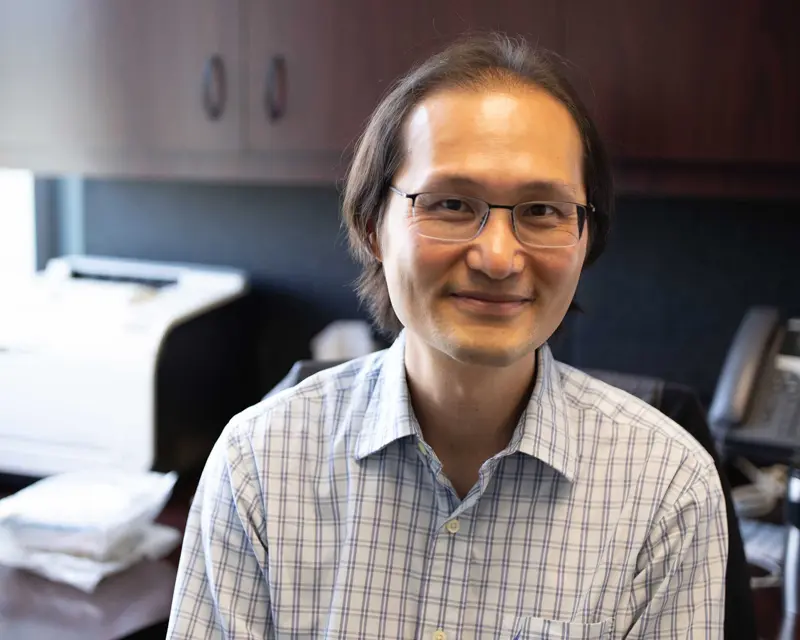
Yuk-Lap (Kevin) Yip, PhD, the Andrew and Erna Viterbi Distinguished Chair and director of the Center for Data Science and Artificial Intelligence at Sanford Burnham Prebys. Image credit: Sanford Burnham Prebys.
The secret identity of a cell cycle regulator in cells that don’t cycle
Cell proliferation protein cyclin D1 paradoxically promotes inflammation in non-proliferating senescent cells
In a tale of identities as divergent as “The Prince and the Pauper,” a well-known cancer-causing gene also influences cells in a senescent state meant to prevent cancer.
The Adams lab and an international team of collaborators published findings August 20, 2026, in Nature Aging unpacking this biological paradox, finding that this cell proliferation gene played a distinct role in cells that no longer proliferate. It served as a driver of chronic inflammation linked to age-related disease, marking it as a promising target for future therapies to reduce sustained inflammation and promote healthier aging.
Altered metabolism in senescent cells helps promote destructive inflammation as we age
Study finds new mitochondrial pathway in senescent cells that changes how DNA is stored to expose inflammatory genes
The immune system’s rapid response to danger—called inflammation—is critical for our health, but it should only last as long as needed to stop infections and heal our wounds. As we grow older, however, we accumulate senescent cells that promote chronic inflammation—and which have been linked to many age-related diseases.
Scientists at Sanford Burnham Prebys Medical Discovery Institute, Mayo Clinic and their international collaborators published findings July 29, 2026, in Nature revealing a new connection between energy-producing mitochondria and this sustained inflammation. They also found that blocking a related gene reduced inflammation and promoted healthier aging in mice.
Single-cell sequencing analysis allows seeing the forest and trees
Study demonstrates a new method that makes massive, multidimensional datasets more manageable while preserving rare signals lost by other techniques
Sequencing technologies now routinely capture the RNA transcripts linked to thousands of genes in each cell of a sample. The immensity of these observations presents data scientists with the challenge of structuring and analyzing an output that is like a Rubik’s Cube but with thousands of faces, rows and columns.
To cut this problem down to size, researchers have developed methods to reduce the number of dimensions while preserving as much of the original data as possible. This can, however, lead to the loss of rare but biologically interesting signals, a bit like conservationists protecting a forest while inadvertently losing some unusual trees that may be important to the ecosystem.
In a study led by the Yip lab published in Genome Biology on February 4, 2026, SenNet researchers detailed a new dimensionality reduction method called Single-cell data Analysis with Knowledge inputs from User using Regularized Autoencoders (SAKURA). The research team showed that it helped cluster rare cells and demonstrated its effectiveness in identifying endocrine cell subtypes in the pancreatic islet, highly similar hematopoietic subpopulations and rare senescent cells.
Cellular circuit controls how DNA damage is repaired, affecting risk of disease as we age
Study reveals new information about how to prevent chronic inflammation from zombie-like cells that accumulate with age
In addition to no longer growing and proliferating, the other hallmark of senescent cells is that they have an inflammatory program causing them to secrete inflammatory molecules. Cells “running” this inflammatory program are considered to exhibit the senescence-associated secretory phenotype (SASP). Too many cells with SASP secreting inflammatory molecules can contribute to chronic inflammation in the body. This pervasive inflammation — called “inflammaging” — has been linked to many age-related diseases.
Scientists at Sanford Burnham Prebys and collaborators across the country published findings March 5, 2025, in Nature Communications showing that the mitochondria powering our cells also control the ability of a DNA repair protein to suppress SASP, which may reduce or delay inflammaging.
Additional SenNet Collection studies with Sanford Burnham Prebys coauthors
- “Senotypes define the diverse landscape of senescent cells” in Nature Aging on July 29, 2026
- Karl N. Miller and Peter D. Adams
- “Advancing biological understanding of cellular senescence with computational multiomics” in Nature Genetics on September 15, 2025
- Peter D. Adams, Marcos G. Teneche and Shanshan Yin
- “SenNet recommendations for detecting senescent cells in different tissues” in Nature Reviews Molecular Cell Biology on June 3, 2024
- Adarsh Rajesh, Karina Barbosa, Marcos G. Teneche, Peter D. Adams and Shanshan Yin
- “Spatial mapping of cellular senescence: emerging challenges and opportunities” in Nature Aging on July 3, 2023
- Peter D. Adams and Rebecca A. Porritt