awards Archives - Page 5 of 5 - Sanford Burnham Prebys
Institute News

2017 Fishman Fund Award Ceremony celebrates postdoctoral scholars

AuthorHelen I. Hwang
Date

September 20, 2017

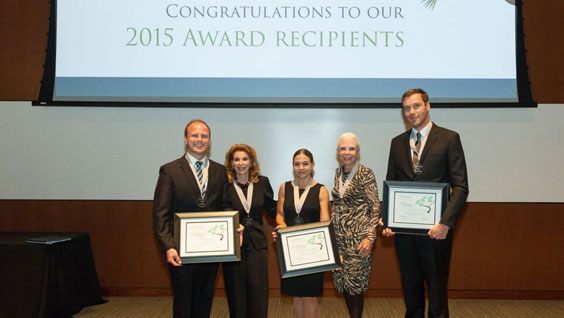
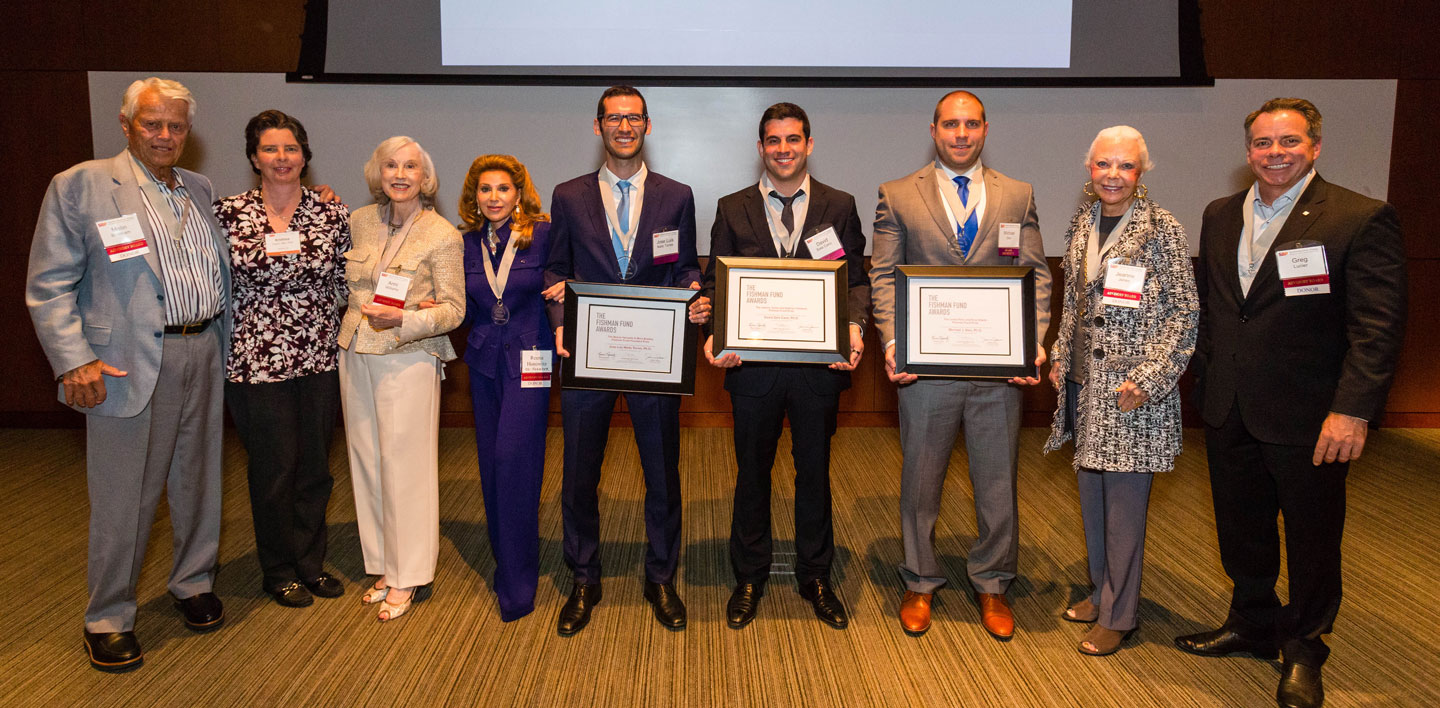
More than 100 supporters of Sanford Burnham Prebys (SBP) Fishman Fund Awards came out to honor this year’s Fishman Fund Award recipients: David Sala Cano, PhD, Michael J. Stec, PhD, and Jose Luis Nieto Torres, PhD, at the Sanford Consortium on Tuesday evening.

Malin Burnham, SBP’s Honorary Board Trustee, spoke about SBP exemplifying collaboration as part of its DNA. He also said that of all the organizations he works with, he gets the most satisfaction from being involved with SBP. Dr. Torres received the award and Fishman Fund medallion from Burnham, while Torres’ parents watched on with pride. They flew in from Spain, visiting the United States for the first time.

Fishman Fund co-founders and SBP supporters Reena Horowitz and Jeanne Jones led the ceremonies as they spoke about the founding of the Fishman Fund Award in 2001. The Fishman Fund Career Development Awards have grown from a $1,500 allowance to $10,000 stipends for each recipient so they can attend workshops, network and travel to national and international scientific conferences to learn about the latest developments in their research fields. The generosity of Fishman Fund donors enables such important career advancement opportunities for future scientific leaders.

Greg Lucier, former SBP board member and CEO of NuVasive, Inc., also spoke on the topic of “we versus me,” emphasizing the importance of teamwork. SBP supporters Dr. Andrew Viterbi, co-founder of Qualcomm, and Armi Williams, Fishman Fund Advisory Board member and former SBP trustee, presented Fishman Fund awards and medallions to Drs. Stec and Cano, respectively.

This year’s recipients gave short presentations on their work, each of which dealt with aging, including muscle stem cells, muscle regeneration and autophagy (body’s ability to eliminate waste and recycle). Read more about their work below.

Your contributions provide vital support for the Fishman Fund. Please donate now.

2017 Fishman Fund Awardees:

David Sala Cano, PhD, a postdoctoral scholar in the laboratory of Alessandra Sacco, PhD, is working on muscle stem cells. He focuses on muscle wasting, a major health problem that leads to poor quality to life, and is associated diseases such as diabetes, chronic kidney disease, cancer and aging. He is working on identifying new targets for drugs that may prevent skeletal muscle degeneration.

Dr. Cano comes to La Jolla from a small town of Abrúcies, Spain. He holds degrees from the University of Barcelona, including a BS degree in biochemistry, a MS degree in physiology and a PhD in biomedicine. His goal is to become a principal investigator in an academic setting, combining his passion for research and teaching.

Michael J. Stec, PhD, focuses on understanding the mechanisms regulating stem cell function and skeletal muscle regeneration; he is also in the laboratory of Alessandra Sacco, Ph.D. He aims to develop novel therapies for improving muscle function in aged and diseased individuals.

Dr. Stec hails from Whippany, New Jersey. He holds a BS degree in health and exercise science from the College of New Jersey, a MS degree in exercise science from Bloomsburg University of Pennsylvania and a PhD in pathobiology and molecular medicine from the University of Alabama in Birmingham. Ultimately, his career goal is to obtain a position in the biotech industry.

Jose Luis Nieto Torres, PhD, is a postdoctoral scholar in the laboratory of Malene Hansen, PhD He conducts research on autophagy—a process our bodies use to eliminate cell waste by recycling debris into usable sources of energy. Our bodies need to be able to eliminate debris that accumulates over time and make new components for proper functioning. Autophagy declines with aging, and is associated with many age-related diseases.

Dr. Torres joined SBP from Palencia, Spain. He obtained his BS degree in biochemistry and biology from the University of Salamanca and MS and PhD degrees in molecular biology from the Universidad Autonoma de Madrid. In the future, Dr. Torres aims to become a principal investigator of his own lab in an academic setting.



Institute News

Ze’ev Ronai wins Lifetime Achievement Award from the Society for Melanoma Research

AuthorJessica Moore
Date

November 10, 2016

Ze’ev Ronai, PhD, chief scientific advisor at Sanford Burnham Prebys Medical Research Institute (SBP) and professor in its NCI-designated Cancer Center, is the 2016 recipient of the Society for Melanoma Research’s Lifetime Achievement Award. The award honors “an individual who has made major and impactful contributions to melanoma research throughout their career.”

Ronai is being recognized for his significant contributions to melanoma research that are advancing understanding of this deadly form of skin cancer and could lead to new treatments. His studies on ultraviolet (UV) irradiation-induced changes that promote melanoma showed how they rewire signaling networks. A major discovery from those inquiries was that one player in that rewiring, a protein called ATF2, can switch from its usual tumor-preventive function to become a tumor promoter. Work by the Ronai lab also mapped how ATF2 contributes to melanoma development, and identified specific factors involved in melanoma response to therapy and metastatic potential.

In mapping the landscape of melanoma signaling, Ronai’s lab also uncovered the important role the enzyme PDK1 plays in melanoma development and metastasis. More recently, Ronai’s studies identified a mechanism underlying resistance of melanoma to BRAF inhibitor therapy, paving the road for a new clinical trial. Integral to Ronai’s research are translational initiatives, including the development of SBI-756, a small molecule that disrupts the complex that initiates protein synthesis and prevents melanoma resistance when combined with BRAF inhibition.

Ronai and his team also study how cancer cells thrive under harsh conditions, such as lack of oxygen or nutrients. That line of research has produced important insights into cancer heterogeneity and its capacity to drive the survival of the select few cancer cells that are resistant to therapy and able to metastasize. Ronai’s studies of proteins that control stress responses, such as Siah and RNF5, have furthered understanding of these processes and identified new targets for future therapies.

Ronai’s record of scientific accomplishments was recognized by the National Cancer Institute with an Outstanding Investigator Award, a seven-year grant that allows recipients to pursue projects of unusual potential. Ronai’s unique focus on how gene activity changes in cancer promises to continue establishing new paradigms for how cancers develop and respond to therapy.

About the Society for Melanoma Research

The Society for Melanoma Research (SMR) is an all-volunteer group of scientists dedicated to finding the mechanisms responsible for melanoma and, consequently, new therapies for this cancer. SMR contributes to advances in melanoma research by catalyzing collaborations among basic, translational, and clinical researchers, carrying new technology-based discoveries from bench to bedside and back.

About melanoma

The incidence of melanoma, the most lethal form of skin cancer, is rising at one of the fastest rates of all cancers in the U.S. Melanoma can strike people of all ages and is the most common form of cancer among young adults ages 25 to 29.

Institute News

Meet the 2016 Fishman Fund awardees

AuthorHelen I. Hwang
Date

September 16, 2016

When Joana Borlido, PhD, got the call that she won the inaugural Fishman Fund Fellowship late on a Friday afternoon, she called her parents, who had been waiting up past midnight in her native Portugal to find out if she had won the prestigious two-year postdoctoral fellowship along with a $5,000 career-development cash grant.

After all, her mother, a science teacher, had inspired Borlido to go into science by bringing home props of human body parts and subscribing to an immunology comic series. Yes, those biology cartoons do exist.

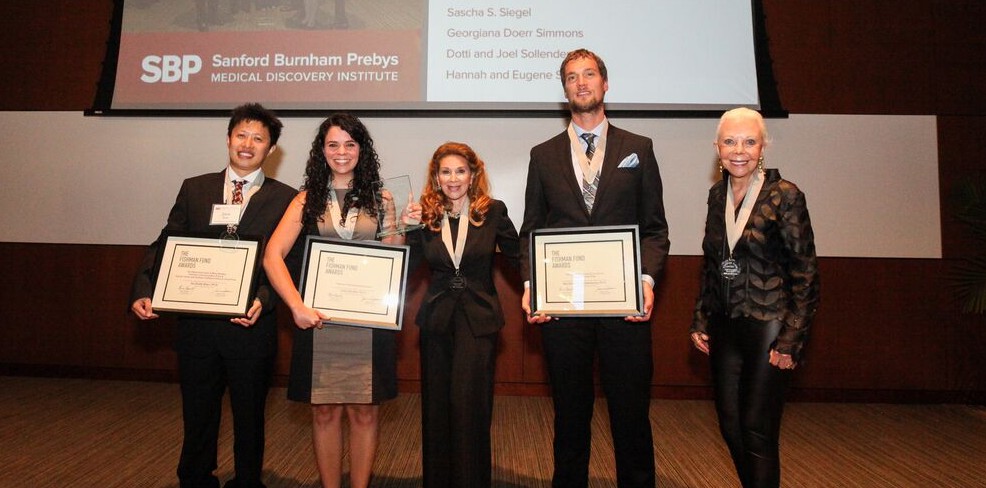
On September 15, the Fishman Fund ceremony honored Borlido and Fishman Fund Career Development recipients Bernhard Lechtenberg, PhD, and Jia (Zack) Shen, PhD

In celebration of SBP’s 40th anniversary, the significance of the Fishman Fund has been elevated with the addition of a two-year postdoctoral award called the Fishman Fund Fellowship. The Fishman Fund Fellowship is an incredible award that not only compensates exceptional postdocs at a higher income level than a typical fellowship, but also comes with a one-time $5,000 flexible career-development award, which they can use to further their professional endeavors. The established Fishman Fund Career Development awards of $10,000 will continue to be awarded as well.

Since the Fishman Fund’s inception in 2001, the Fishman Fund has grown from $1,500 cash awards. It was first established by Horowitz and Mary Bradley in honor of founders Dr. William and Lillian Fishman. In 2010, Jeanne Jones became the co-founder designee.

During the ceremony, Fishman Fund co-founder Reena Horowitz discussed the importance of supporting “the next generation of biomedical trailblazers.” She also said that the “Fishmans believed passionately in cultivating early-stage scientific talent. They knew that young investigators must focus intently on honing research skills and gaining professional experience.” Horowitz also took a moment to honor friends and supporters who have passed: Mary Bradley, Erna Viterbi, Pauline Foster, and Conrad Prebys.

Nina Fishman, daughter of SBP founders Dr. William and Lillian Fishman, read from a speech her father gave at the Institute. He said, “Each is encouraged to develop original ideas, which can be tested experimentally and subsequently qualify for grant support. Together we have the ‘critical mass’ of intellectuals and skills to accelerate progress in sciences.” She added that the Institute has demonstrated that a “relatively small but highly focused group can provide a nucleus where the whole is greater than the sum of its parts.”

Past winner Petrus de Jong, MD, PhD, shared how the Fishman Fund has boosted his career. With the grant, de Jong attended a drug delivery systems symposium with biotech entrepreneurs, participated in a research symposium in pancreatic cancer and received tailored career advice from senior scientists. “These events have been crucial for my personal career development, which would not have been possible without the Fishman Fund Award,” he said.

Fishman Fund Fellowship Awardee:

Joana Borlido, PhD, explores the mechanisms through which the channels that connect the cell nucleus (where the genome is stored) affect the immune system. She works in the laboratory of Maximiliano D’Angelo, PhDHer work will help elucidate the molecular basis for the onset and development of leukemia.

She completed her PhD in Oncology at the University of Cambridge in the U.K. and her BS in Biology at the University of Porto in Portugal.

If Borlido is not in the lab, she can usually be found playing foosball, which she admits she would play during all her free time if she could.

Fishman Fund Career Development Recipients:

Bernhard Lechtenberg, PhD, studies cellular signaling networks in normal human physiology and diseases in the laboratory of Stefan Riedl, PhDLechtenberg uses protein X-ray crystallography to study diseases such as cancer and ALS (Lou Gehrig’s disease). He received his BS and MS from the University of Luebeck in Germany and his PhD from the University of Cambridge in the U.K.

In his spare time, he and his wife Anne Hempel, also a SBP postdoc, participate in Ragnar Relay races, in which a team runs nonstop day and night to complete a course of almost 200 miles.

Jia (Zack) Shen, PhD, develops functional screens of for drugs that inhibit ubiquitin ligases (enzymes that tag proteins with a small protein called ubiquitin). Such drugs, alone and in combination with current chemotherapies, are considered important advances in the therapy of breast cancer patients. Shen works in the laboratory of Charles Spruck, PhD, and received his BS from Zhejiang Sci-Tech University and his PhD from the Chinese Academy of Sciences.

He and his wife love taking their 6-month-old daughter Olivia for walks in San Diego. Shen also plays soccer twice a week with a team at the Salk Institute.

With the generous support of the Fishman Fund, this stellar group of postdocs will benefit tremendously from well-earned rewards for their hard work and vision for “Science Benefiting Patients.”

Institute News

SBP researcher receives NIH Outstanding Investigator Award to study deadly pathogens

AuthorSusan Gammon
Date

June 7, 2016

Francesca Marassi, PhD, professor in SBP’s NCI-designated Cancer Center, has been awarded an Outstanding Investigator Award from the National Institute of General Medical Sciences (NIGMS). The $4 million grant is to study how proteins on the surface of pathogens promote virulence by mediating the first-line interactions with human host cells. The project has important implications for biology and medicine.

“Our initial focus is on a protein called Ail (attachment invasion locus) that is expressed on the outer membrane of Yersinia pestis, the causative agent of plague,” said Marassi. “The Y. pestis bacterium is highly pathogenic, spreads rapidly and causes an extremely high rate of mortality. Ail is critical for suppressing the human immune defenses and for promoting bacterial invasion”

Although it is sensitive to some antibiotics, the potential use of Y. pestis as a biological weapon has led to its classification as a Tier 1 Biothreat Agent – a designation used by the U.S. Department of Health and Human Services to identify pathogens and toxins that can be misused to threaten public health or national security.

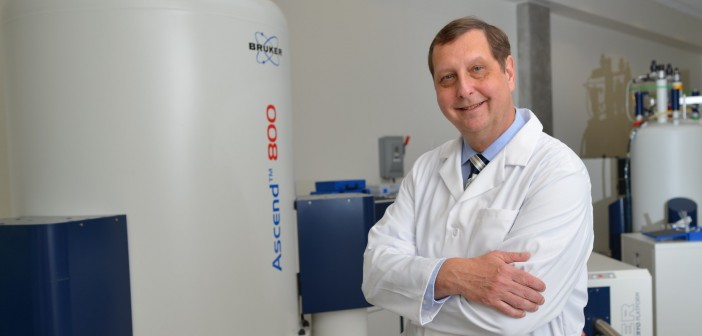
“The emerging threat of bacterial drug resistance makes our work particularly important,” added Marassi. “We will be using a technology called NMR (nuclear magnetic resonance) to determine the three-dimensional structure of Ail and examine how it associates with its human protein partners. Visualizing these biomolecular complexes helps us understand how pathogens engage their human host, and advances our ability to design effective drugs and vaccines for bacteria and viruses,” added Marassi.

Institute News

Doug Lewandowski, PhD, elected as a Fellow of the American Association for the Advancement of Science

AuthorJessica Moore
Date

April 28, 2016

The director of Translational Cardiovascular Research at SBP’s Lake Nona campus was recently named a Fellow of the American Association for the Advancement of Science (AAAS). E. Douglas Lewandowski, PhD, was one of 33 scientists selected to become a AAAS fellow in the Section on Medical Sciences, recognizing his “distinguished contributions to fundamental aspects of cardiac metabolism and their implications for heart disease.” Continue reading “Doug Lewandowski, PhD, elected as a Fellow of the American Association for the Advancement of Science”

Institute News

Peter Crawford, MD, PhD, elected to the American Society for Clinical Investigation

Authorjmoore
Date

April 19, 2016

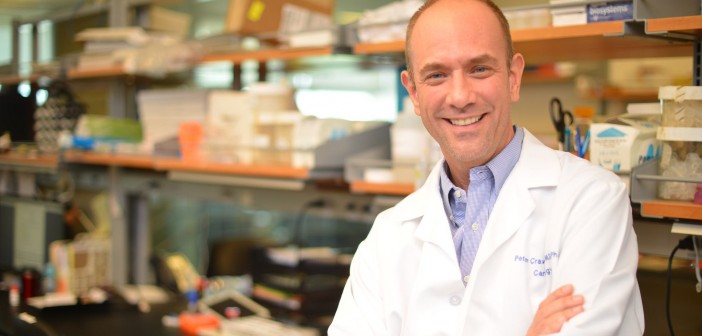
The director of SBP’s Cardiovascular Metabolism Program was recently elected into a pre-eminent honor society for physician-scientists. Peter Crawford, MD, PhD, was one of 74 medical researchers whose nominations to the American Society for Clinical Investigation (ASCI) were accepted in 2016. This distinction is conferred only on investigators who have made significant scientific advances prior to the age of 50. Continue reading “Peter Crawford, MD, PhD, elected to the American Society for Clinical Investigation”

Institute News

New STRIVE awards announced

Authorsgammon
Date

October 8, 2015

“The STRIVE award is providing funds that allow us to accelerate the testing of a new hypothesis that connects the microbiome, epigenetics, and colorectal cancer.”        

          –Alex Strongin, PhD professor in the Bioinformatics and Structural Biology Program at SBP. Continue reading “New STRIVE awards announced”

Institute News

2014 Fishman Fund Awards announced

Authorrbruni
Date

October 6, 2014

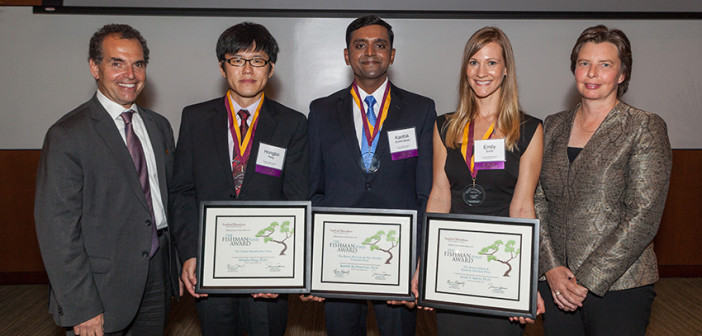
Three gifted and promising young postdoctoral researchers were presented the prestigious Fishman Fund Award at the annual ceremony on October 2. More than 50 generous benefactors and past award winners joined the celebration to congratulate the young scientists and encourage them to continue their research careers. Continue reading “2014 Fishman Fund Awards announced”