community Archives - Page 8 of 9 - Sanford Burnham Prebys
Institute News

Getting groovy for a good cause at Bring It!

AuthorMonica May
Date

May 9, 2019

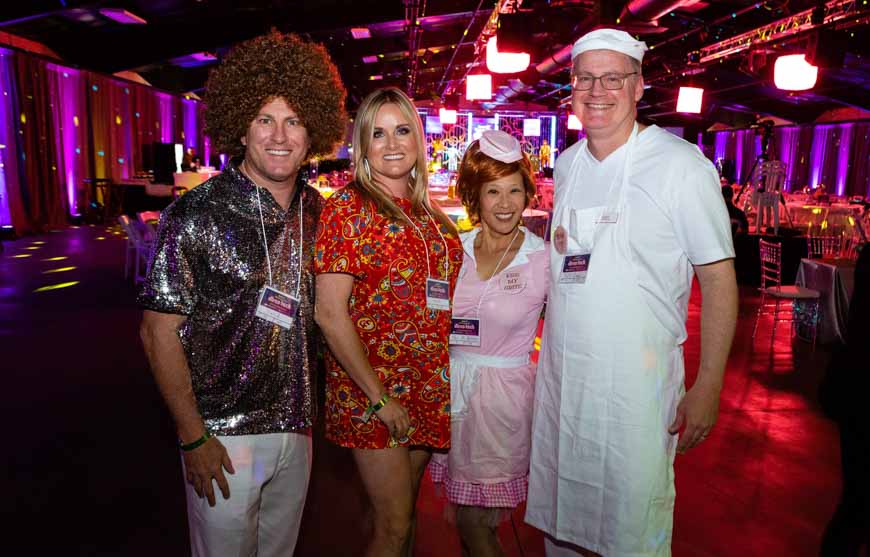
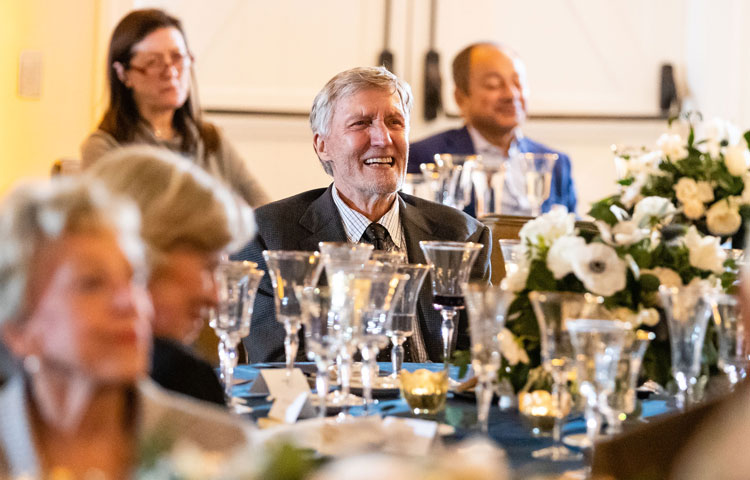
From the moment guests stepped into the disco-lit room, it was clear Bring It! was not your typical fundraiser. 

Donned in bell bottoms, sequined bodysuits and platformed heels, this year’s guests sampled hors d’oeuvre’s supplied by roller-blading servers and grooved to classics such as “Stayin’ Alive” and “Dancing Queen.” 

The 70’s-themed event, held on May 2, 2019, at the Del Mar Fairgrounds, drew a crowd of more than 400 attendees—the largest yet—a testament to the hard work and dedication of co-chairs Juli Oh and Matt Browne, and Sarah and David Szekeres. John Weisbarth, host of Tiny House Nation and San Diego native, emceed the event for the third year in a row.

While fun was had by all, the night’s mission was never far from anyone’s mind: fundraising for our Institute’s work to find cures for diseases such as Alzheimer’s, cancer, heart disease, diabetes and more. 

Co-chair Sarah Szekeres shared her personal story about why research is important to her: “Learning I have the BRCA2 gene mutation, which puts me at a greater risk of breast and ovarian cancer, has been an overwhelming and frightening experience for me and my family. It’s through basic research that we will develop effective medicines or tests that prevent, diagnose or treat disease—and create a future where my daughter, and her children and grandchildren, aren’t afraid of cancer or Alzheimer’s or the many serious diseases our society faces today.”

Guests vied for an opportunity to participate in onstage competitions—a spot so coveted it was raffled to the highest bidder. Top-scoring teams partook in absurdly hilarious games, such as “Hungry Hungry Human,” where guests attempted to collect plastic balls from an inflated pool while wheeled on a dolly; and “Rocky,” where participants furiously boxed and ran in place to reach the most steps on a pedometer. Despite wearing wigs and hats, contestants even braved a bobbing-for-apples style competition involving candy encased in a Jello Mold.

Altogether, Bring It! certainly puts the “fun” in “fundraising needs.” We hope to see you next year—stay tuned for more details about the date and theme of the event.  

We are extremely grateful to the event’s generous sponsors, including Alexandria Realty, Heron Therapeutics, Marleigh and Alan Gleicher, Cooley, Marilena and Greg Lucier, Retrophin, Domain Associates, Robin and Hank Nordhoff, Jeanne Herberger, PhD, Moon Valley Nurseries, Bank of America Merrill Lynch, Luke and Elizabeth Bonacci, Sarah and David Szekeres, Jonell and Gregory Tibbitts, Court and Julie Turner, Dulcy and Mason Matthies, Josie and Jim Myers, Marie Simmons, Arena Pharmaceuticals, BDO, CBRE, Creative Fusion, Cushman & Wakefield, IDT, Deloittte & Touche, Farrell Family Foundation, iProtean, KPMG, Johnson & Johnson, Marsh & McLennan Agency, Neurocrine Biosciences, Oxford Finance, Pegasus Building Services, UnionBank, Cabrillo Advisors, Square1bank and USI Insurance Services. 

Watch a fun-filled KUSI segment about the event. 

Head to our Facebook page to view event photos; search #BringIt19 to find more content. 

Interested in keeping up with our latest discoveries, upcoming events and more? Subscribe to our monthly newsletter, Discoveries.

Institute News

Inspiring future scientists at the STEM EXPO

AuthorMonica May
Date

March 25, 2019

Armed with wiggly worms and striped zebrafish, on Saturday, March 2, more than 20 volunteers from Sanford Burnham Prebys helped kids and their families learn about the power of DNA at the San Diego Festival of Science & Engineering’s EXPO Day. 

One of the largest STEM (Science, Technology, Engineering and Math) festivals in the U.S., this year’s event featured more than 130 interactive exhibits designed to ignite a passion for science in K–12 students. Despite an uncharacteristically rainy morning, an estimated 17,000 people attended. 

For Joseph Lancman, PhD, a postdoctoral researcher at our Institute who was the first in his family to graduate from college, the festival was an opportunity to provide children with the experience he wishes he’d had as a kid.

“Growing up, I knew I was interested in human health, but I had no idea that research was an option,” Lancman says. “Like many kids, I thought I wanted to be a doctor. But in college, I quickly learned that I wanted to know more. I wanted to know what causes disease and how scientists go about finding cures.” 

STEM EXPO 2019 Joseph Lancman and son

Dr. Lancman and his son

At our booth, postdoctoral researchers, graduate students and staff helped children don paper lab coats and explore DNA-themed activities. 

Children were able to see live worms with DNA mutations that affect their movement, courtesy of the lab of Malene Hansen, PhD, professor in the Development, Aging and Regeneration Program. Compared to normal worms, some mutant worms moved mindlessly in circles, and others remained relatively immobile—illustrating how changes in a DNA sequence can dramatically affect life.

At the adjacent station, provided by the lab of Duc Dong, PhD, assistant professor in the Human Genetics Program, children squinted through microscopes and peered into fish tanks to observe how DNA changes can dramatically affect the heartbeat of zebra fish—one of the most powerful model organisms used to study vertebrate biology. 

Lancman, who works in Dong’s lab, took care to explain the exhibit in child-friendly language (he credits his four-year-old son for helping him develop this skill). 

“I want kids to know that science is like a puzzle,” he explains. “It takes time to put all the pieces together, but when you’re done, you can see the big picture—and that big picture can lead to improving human health.”

Institute News

5 takeaways from Insights: Heart Disease

AuthorMonica May
Date

February 15, 2019

It’s easy to forget about the fist-sized organ in our chest. But the heart is arguably the most important muscle in the body. We can’t live without it, after all. 

To help educate the public about heart health and share the latest scientific advances, this month Sanford Burnham Prebys Medical Discovery Institute (SBP) invited the San Diego community to a free panel discussion focused on the heart. 

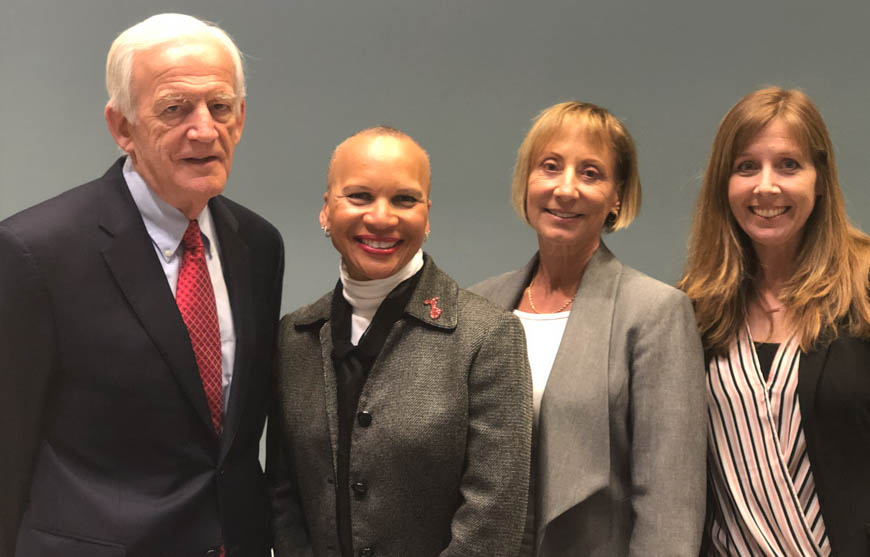
More than 70 community members attended the event, whose speakers included cardiologist Anthony N. DeMaria, MD; Jack White, chair in Cardiology, professor of Medicine, founding director, Sulpizio Cardiovascular Center at UC San Diego Health; Donna Marie Robinson, an individual living with heart failure; and heart researcher Karen Ocorr, PhD, assistant professor, Development, Aging and Regeneration Program at SBP. Jennifer Sobotka, executive director at the American Heart Association San Diego, moderated the discussion.

In a special introduction provided by Rolf Bodmer, PhD, director and professor in the Development, Aging and Regeneration Program at SBP, he explained that his heart research uses model organisms such as the fruit fly. He quipped, “Which some of you didn’t even know had a heart.” 

The ensuing discussion was robust and insightful. Below are five important takeaways: 

  1. Heart disease is the number-one killer of Americans. Nearly half of American adults have some form of heart or blood vessel disease.
  2. Obesity is an epidemic in America. In the 1960s, approximately 13 percent of American adults were obese, according to the Centers for Disease Control (CDC). Today, that number has tripled to nearly 40 percent. DeMaria illustrated this point with a colored map showing obesity’s prevalence during each decade, which drew gasps from the crowd. 
  3. Know your numbers. Donna Marie was healthy and fit, so she didn’t think that a fainting episode could have been heart disease. “My cardiologist saved my life,” she said. Now, she encourages everyone to “know your numbers, including your cholesterol level and your blood pressure.” 
  4. Rethink swatting that pesky fruit fly. We share 80 percent of disease-causing genes with the tiny insect, including ion channels that keep the heart pumping. For this reason scientists are studying fruit-fly hearts in an effort to learn about the many mysteries of the heart, such as how the rhythm disorder atrial fibrillation (AFib) arises. 
  5. Consider moving to Italy. Just about everyone wants to know which science-backed diet to follow for optimal health. DeMaria explained that the most robust data supports eating a Mediterranean diet rich in fruits, vegetables and olive oil.

Read the La Jolla Light’s coverage of the event. 

Institute News

Padres Pedal the Cause presents record-breaking check for nearly $3 million to fund local cancer research

AuthorMonica May
Date

January 29, 2019

Local cancer research just got a big boost. 

On Thursday, January 24, SBP president Kristiina Vuori, MD, PhD, joined leaders from Moores Cancer Center at UC San Diego Health, Salk Institute for Biological Studies and Rady Children’s Hospital–San Diego to help Padres Pedal the Cause (PPTC) reveal that this year’s event raised a record-breaking $2.9 million for local cancer research. The leaders joined executive director Anne Marbarger onstage to receive the official check. 

This year’s event—which invited participates to cycle, spin, run or walk—had more than 2,500 participants, an increase of 35 percent. Total fundraising grew by 22 percent. SBP has participated in the event since its inception; and this year our team of more than 60 scientists, staff and SBP supporters raised more than $30,000 for the cause. Since the inaugural ride six years ago, PPTC has raised more than $10 million.

Nearly 300 of the event’s participants, including Tony Gwynn Jr., Pedal founders Bill and Amy Koman, San Diego business leaders, and top donors and fundraisers, gathered at the Del Mar racetrack to witness the funding reveal and check presentation in person. 

Gwynn shared a moving story about his father’s battle with salivary cancer, a journey he still finds difficult to recount. “If he saw this progress, he would be smiling today,” he said. 

A full 100 percent of the proceeds fund collaborative research taking place at the four San Diego research institutes. Past PPTC grants have accelerated SBP’s research into cancers of the breast, skin, brain, colon, pancreas and more. This year’s grant announcement will be revealed in the spring. 

In the meantime, make sure to mark your calendars for the 2019 event, which will take place on Saturday, November 16. Registration will open in mid-April.

Interested in keeping up with SBP’s latest discoveries, upcoming events and more? Subscribe to our monthly newsletter, Discoveries. 

Institute News

Highlights from the 2018 Faculty Retreat

AuthorSusan Gammon
Date

June 4, 2018

SBP’s annual Faculty Retreat was held May 30–31 in beautiful Carlsbad, California.

This year’s theme was “Fundamental Cellular Processes in Health and Disease,” and featured 20 speakers from SBP areas of expertise:

·         Development and Aging — Malene Hansen, PhD, Lorenzo Puri, MD, PhD, Karen Ocorr, PhD, Alexey Terskikh, PhD, and Rolf Bodmer, PhD

·         Immunity and Inflammation Rob Weschler-Reya, PhD, Linda Bradley, PhD, Scott Peterson, PhD, and Jeff Smith, PhD

·         Technology Platforms — Dorit Hanein, PhD, Sumit Chanda, PhD, and Niels Volkmann, PhD

·         Drug and Disease Targets — Michael Jackson, PhD, Garth Powis, PhD, Wanda Reynolds, PhD, Elena Pasquale, PhD, and Matt Peroski, PhD

·         Share Resources Update — Craig Hauser, PhD

Special congratulations to Duc Dong, PhD, and Crystal Zhao, PhD, both of whom were officially promoted to associate professors.

Faculty promotion
Pictured (left to right): Duc Dong, PhD, Elena Pasquale, PhD and Crystal Zhao PhD

Dong, in the Human Genetics Program, is advancing research in cell/organ replacement therapy that may ultimately benefit patients with diabetes and Alagille syndrome—a genetic disorder that can affect the liver, heart and other parts of the body.

Zhao, in the Tumor Initiation and Maintenance Program, is studying the regulation of neural stem cells—research that may lead to therapies for neurological diseases, including Alzheimer’s disease, Parkinson’s disease, and mental health disorders that affect cognitive abilities.

A highlight of the annual retreat is the presentation of the “WOW” award, which stands for Wonderful Original Work. This year, the WOW was given to Robert Wechsler-Reya, PhD, who won for his presentation titled “Overcoming Immune Evasion in Pediatric Brain Tumors.”

Wechsler-Reya’s research goal is to advance immunotherapy for medulloblastoma tumors—the most common malignant brain tumor in children. By increasing certain cell surface molecules called MHC on these cancer cells, he believes he can improve the ability of T cells to recognize the tumors and kill them.

Wechsler-Reya is a professor in the Tumor Initiation and Maintenance Program at SBP and is also the program director for the Joseph Clayes III Research Center for Neuro-Oncology and Genomics at Rady Children’s Institute for Genomic Medicine.

Cosimo Commisso, PhD, and Crystal Zhao, PhD, served as faculty organizers.

And many thanks to Wendy Lyon and Nelson, the research administrative specialists who organized the event.

Institute News

SBP brings science to San Diego community at STEM

AuthorSusan Gammon
Date

March 8, 2018

STEM Expo Day kicked off a week-long festival on Saturday, March 3, 2018 at Petco Park. The event marked the 10th annual San Diego Festival of Science and Engineering Expo Day—one of the largest STEM (Science, Technology, Engineering and Math) festivals in the U.S. The community outreach event provided learning and hands-on activities for students in grades kindergarten through 12th grade, as well as adults and families to ignite their passion for STEM education.

“STEM Expo is a great way to get our future researchers excited about science, and I believe that’s why SBP’s involvement continues to expand,” said Karen Ocorr, PhD, an SBP faculty member who organized a research demonstration for the exhibit booth.

About 40 SBP volunteers, including faculty, postdocs, staff and graduate students, worked in three shifts throughout the day to talk with visitors and guide them through two sets of interactive programs.

Ocorr set up a station where children received paper lab coats with personalized name tags to explore the food preferences of fruit flies and how it affects their heart health. Visitors used microscopes and high-powered LED magnifying glasses to look at fly abdomens to see if they had eaten sugar (dyed red) or fat (dyed blue). Not surprisingly, the fruit flies prefer a high sugar diet. Ocorr shared videos of beating fly hearts showing that both high sugar and high fat are bad for heart function.

The second station gave visitors an opportunity to interact with models of drugs and human proteins made by a 3D printer, courtesy of Adam Godzik, PhD, director of the Bioinformatics and Structural Biology Program at SBB. Godzik’s lab also brought glasses for viewing a virtual reality program showing how protein folding configurations are used to design drugs.

The event, which was free and open to the public, had more than 130 interactive exhibits with hands-on learning activities.

In spite of rain an estimated 25,000 people participated in EXPO Day at Petco Park.

Institute News

Remembering Dongxian Zhang

AuthorKristen Cusato
Date

March 31, 2017

Dongxian Zhang, PhD, our valued colleague, collaborator, mentor and friend, recently passed away after a long illness.

Dongxian had been with SBP since the fall of 1999. He came to us from Harvard Medical School. “He was a valued associate professor in our Degenerative Diseases Program and served as an adjunct assistant professor in the Department of Molecular Pathology at UC San Diego since 2004,” says Kristiina Vuori, MD, PhD, president of SBP. “His positive and helpful personality will be missed and always remembered.”

“He told me he was surprised that he had been accepted to college, but that acceptance motivated him to go on to make major contributions to his chosen field of study,” says Randal Kaufman PhD, director of the Degenerative Diseases Program.

“When Dongxian shared the news about his diagnosis, he was incredibly brave and at peace with his life,” says Kaufman. “I will truly miss my friend. I will also miss the times we played golf. We enjoyed the camaraderie, which I will never forget.”

Dongxian made key advances in the study of motor neuron degeneration, including the discovery of novel neuroprotective factors and biomarkers of early events in disease pathology. Recent findings in collaboration with Huaxi Xu, PhD, professor at SBP, should be published soon and may lead to new diagnoses and treatments for motor neuron diseases.

Xu says he will remember his friend for his gentle demeanor and extreme dedication to his trainees. “Dongxian would never hesitate to jump into the lab to finish an experiment, calibrate instruments or perform molecular biology to help out members of his lab, as well as our lab,” Xu says. “His illness came as a surprise to everyone. He faced his sickness with great integrity and humor.”

“To me, he was more than a mentor for my work but also to my life,” says Lu-Lin Jiang, PhD, who worked in Dongxian’s lab. “He gave us much freedom to explore the beauty of the science. He took care of us like he took care of his own kids. When he was recovering from his first brain surgery, he told us he was not afraid of death, but he was worried about us. Later, he tried to help us to find new positions. Dongxian was the most positive person I have ever met.”

Dongxian leaves behind his wife Dong-Er Zhang and two sons, David and Phillip. We offer our sincere condolences to his family.


More about Dongxian Zhang

In 1969, during the Culture Revolution in China, Dongxian, like many students in big cities, was sent from Shanghai to a rural village to be “re-educated” by farmers. He was only 16 years old and had completed less than one year of middle school. When the Revolution ended in 1977, the Chinese government reopened enrollment for college entrance and Dongxian took the national college entrance exam. Using textbooks he borrowed from the headquarters of a local railroad, he taught himself enough middle and high school subjects to receive one of the top 10 exam scores in Yunnan province in 1978. He went on to study at Peking University, one of the most prestigious in China.

Dongxian was hoping to write a novel based on his life experience, but sadly this never happened.

Institute News

Showing kids why mutants matter at the STEM Expo

AuthorJessica Moore
Date

March 7, 2017

Want to see some mutant worms? If you do, you’re like the hundreds—or possibly thousands—of children and their parents who visited the Sanford Burnham Prebys Medical Discovery Institute (SBP) booth at the STEM Expo, held Saturday, March 4 to kick off the San Diego Festival of Science and Engineering.

Those families got to watch live C. elegans—tiny worms used at SBP to study the biology of aging—move under a magnifying glass. By comparing normal worms to mutants that don’t move as well, they learned about how a single change to DNA can have a huge impact on how a whole body works. Scientists from the lab of Malene Hansen, PhD, associate professor at SBP, who provided the worms, explained how mutations in the same gene also cause human diseases like Ehlers-Danlos syndrome, which involves hyperflexible joints and skin.

They also had the chance to use virtual reality headsets to look at the shapes of proteins—the machines that make things happen inside cells—and how they can change as a result of a mutation. The 3D visualization tool was created by the lab of Adam Godzik, PhD, professor and director of the Bioinformatics and Structural Biology Program at SBP. Researchers from Godzik’s group told visitors about how they use similar computer modeling to find new mutations that could be important in cancer.

Kids left the SBP booth with temporary DNA tattoos on their hands (or sometimes their faces), mini lab coats personalized on the spot so they could pretend to be scientists at home and, maybe, a newfound interest in biology, thanks to the enthusiasm of the Institute’s many volunteers.

Institute News

SBP friend and supporter Gary K. Herberger has passed away

AuthorHelen I. Hwang
Date

March 6, 2017

With great sadness, Sanford Burnham Prebys Medical Discovery Institute (SBP) announces the passing of Gary K. Herberger, one of our most cherished friends and supporters, who died on February 28 after battling a long illness.

“With Gary’s passing, the SBP community has lost a treasured friend, and biomedical research has lost a staunch advocate. I was personally honored to be the inaugural holder of our endowed Jeanne and Gary Herberger Leadership Chair in Cancer Research. Gary’s legacy continues to live on as Garth Powis, D.Phil., director of the National Cancer Institute-designated Cancer Center, now holds the Jeanne and Gary Herberger Leadership Chair in Cancer Research. In addition, Huaxi Xu, PhD, director of the Neuroscience Initiative, was recently named as the Jeanne and Gary Leadership Chair in Neuroscience,” said Kristiina Vuori, MD, PhD, president of Sanford Burnham Prebys Medical Discovery Institute (SBP).

“Gary’s extraordinary achievements were rooted in his gentle soul and generous spirit,” said Jeanne Herberger, PhD, his wife of 50 years and his life partner in business and philanthropy. “He believed that his purpose in life was to serve humankind, so he always focused on the needs of others.”

T. Denny Sanford, SBP boardmember, said, “I will always cherish the wonderful memories of my friendship with Gary. His record of accomplishment as a distinguished architect and a benefactor to many institutions is unsurpassed. I will miss Gary, and I know the world will miss him.”

“Gary was a true legend in the real estate world because he had a rare combination of immense architectural design talent and outstanding development skill and expertise. The range of his projects was truly remarkable, but they all had one thing in common: You could see, at a glance, their uniqueness and their sheer quality. I feel so fortunate to have known him,” added SBP boardmember Malin Burnham.   

As president of Herberger Enterprises, Inc., Herberger propelled Arizona’s modern growth through his innovative real estate development and vigorous philanthropic leadership.

He got his start in architectural design as a young apprentice to Frank Lloyd Wright. Under Wright’s tutelage, he worked on the Guggenheim Museum in New York City and Grady Gammage Auditorium in Tempe, Arizona. After the eminent architect’s death in 1959, Herberger completed Wright’s project at Wichita State University in Kansas.

The Herbergers married in Minneapolis, Minnesota in 1967. Over the last few decades, the couple split their time between homes in Rancho Santa Fe, California and Paradise Valley, Arizona.
 

Institute News

Reena Horowitz honored at Sanford Burnham Prebys Medical Discovery Institute

AuthorHelen I. Hwang
Date

December 13, 2016

During a special end-of-the-year gathering, Reena Horowitz was honored for her hard work and dedication to Sanford Burnham Prebys Medical Discovery Institute (SBP). Held in the Fishman Auditorium at SBP, friends and staff thanked Horowitz with a bouquet of flowers, applause and a speech from Kristiina Vuori, PhD, president of SBP. Vuori thanked Horowitz for being a “leading ambassador for the Institute.”

In Vuori’s speech, she explained how Horowitz became involved with the Institute through her friendship with her neighbor Lillian Fishman. Dr. William T. Fishman and his wife, Lillian Fishman, founded SBP forty years ago. “Reena’s friendship with Lillian provided the Institute with a champion in the community, as well as the development of two of SBP’s institutional programs, the Fishman Fund Awards and the Group of 12 & Friends. Reena co-founded and has managed both of these extraordinary programs for over a decade,” said Vuori.

To nurture the careers of future scientific trailblazers at SBP, the Fishman Fund was established by SBP supporters Mary Bradley and Reena Horowitz to honor the founders of the Institute, Dr. William and Lillian Fishman. Over 55 postdoctoral students have been supported by the Fishman Fund, which awards postdoctoral fellowships and career development grants.

Horowitz co-founded G12 & Friends, a lecture and get-together with friends hosted monthly at SBP. What started out as Horowitz, Lillian Fishman and a few friends has ballooned into a group that usually draws over 100 guests, curious about a wide range of topics from science, medicine and the arts.

The celebration was an occasion to thank Horowitz for being a passionate supporter of SBP’s scientific programs within the community.

To find out more about the Fishman Fund and how to support it, click here.