Evan Snyder Archives - Page 2 of 2 - Sanford Burnham Prebys
Institute News

Year in review: Top stories in 2017

AuthorSusan Gammon
Date

January 9, 2018

In the last 12 months, SBP scientists published 338 scientific papersthat’s almost a paper a day. We are proud of this impressive achievement, and equally proud of the quality of research in these scientific studies. Whether you are seeing them for the first time or coming back for another look, check out the most popular stories from SBP’s researchers in 2017.

  1. Scientists take a deeper dive into cellular trash
    Malene Hansen, PhD, led the first-ever comprehensive analysis of autophagy in a living animal during aging. The study was published in eLIFE.  
  2. Drug short-circuits cancer signaling
    A drug that zeroes in on mutated nuclear receptors found in cancer will soon be entering Phase 1 clinical trials at the Dana Farber Cancer Center for patients with colorectal cancer. Research by Xaio-kun Zhang, PhD, describes how the targets cancer but leaves normal proteins alone.
  3.  Biomarker may predict early Alzheimer’s disease
    Erkki Ruoslahti, MD, PhD, has discovered a new approach to detect Alzheimer’s disease at its earliest stages. His research team found a biological marker, or biomarker, that’s associated with brain inflammation—a trigger for the Alzheimer’s process, which takes many years to produce symptoms. 
  4.  Steps toward a promising therapy for a rare bone disease
    Yu Yamaguchi, MD, PhD, led a study proving fresh insight into the mechanism of multiple hereditary exotoses (MHE)—a rare disease that causes the growth of multiple benign bone tumors. The research opened the door for testing the drug palovarotene in Phase 2/3 clinical trials for patients with MHE.
  5. New insights into bipolar disease
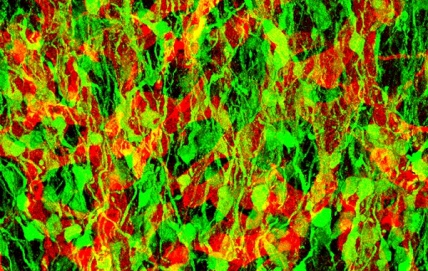
    An international collaborative study led by Evan Snyder, MD, PhD, was first to explain the molecular basis of bipolar disease and may support the development of a diagnostic test for the disorder. The research may also help scientists develop tools to predict the likelihood of patient response to lithium treatmenta highly effective drug that works in only 30% of bipolar patients.
Institute News

New Department of Defense grant funds efforts to treat ALS with stem cells

Authorjmoore
Date

January 28, 2016

Evan Snyder, MD, PhD, director of the Center for Stem Cells and Regenerative Medicine and a professor in SBP’s Human Genetics Program, was awarded a grant to develop a stem cell treatment for amyotrophic lateral sclerosis (ALS). ALS, also known as Lou Gehrig’s disease, involves degeneration and death of motor neurons (which control voluntary muscles), causing difficulty speaking, swallowing, and eventually breathing. No available treatments can slow the progression of ALS, which affects approximately 20,000 people in the U.S.

As new therapies are urgently needed, the Department of Defense announced a funding program for new therapeutic ideas in ALS in 2015. Snyder received one of eight grants awarded in this competitive program.

This grant will support research on human neural stem cells (hNSCs) as an approach to support the survival and function of existing motor neurons. The Snyder lab is modifying hNSCs so that they can be administered via the bloodstream and home to the spinal cord. This strategy allows the stem cells to become distributed throughout the spinal cord, overcoming a previous limitation. Snyder’s team has already shown that transplanted NSCs improved motor performance, respiratory function, and symptom-free survival in a mouse model of ALS.

hNSCs are already in phase I clinical trials for ALS, which have shown that this therapy is safe. These trials were possible in part because of the Snyder lab’s pioneering work in preclinical models. The current research promises to lead to an improved version of this therapy.

Institute News

Stem cell model reveals molecular cues critical to neurovascular unit formation

Authorsgammon
Date

June 1, 2015

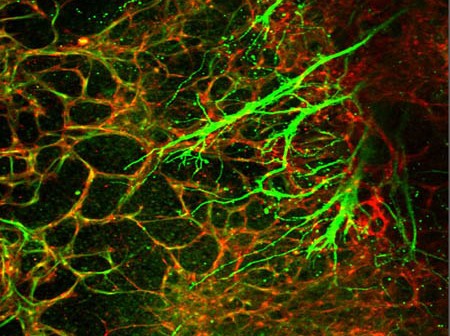
Crucial bodily functions we depend on but don’t consciously think about — things like heart rate, blood flow, breathing, and digestion — are regulated by the neurovascular unit. The neurovascular unit is made up of blood vessels and smooth muscles under the control of autonomic neurons. Yet how the nervous and vascular systems come together during development to coordinate these functions is not well understood. Using human embryonic stem cells, researchers at Sanford-Burnham, University of California, San Diego School of Medicine, and Moores Cancer Center created a model that allows them to track cellular behavior during the earliest stages of human development in real-time. The model reveals, for the first time, how autonomic neurons and blood vessels come together to form the neurovascular unit. The study was published May 21 by Stem Cell Reports. Continue reading “Stem cell model reveals molecular cues critical to neurovascular unit formation”

Institute News

Sanford-Burnham presents at the 2014 Society for Neurosience Meeting

Authorsgammon
Date

November 13, 2014

The Society for Neuroscience’s 44th annual meeting is the premier venue for neuroscientists to present emerging science, learn from experts, forge collaborations, and learn about new technologies and tools. Sanford-Burnham has several dynamic research programs in neuroscience, and below are our presentations scheduled for this year’s event. Continue reading “Sanford-Burnham presents at the 2014 Society for Neurosience Meeting”

Institute News

11th annual Christopher Reeve “Hot Topics” in stem cell biology

Authorsgammon
Date

November 11, 2014

On November 17, 2014, an evening of data “blitzes” on stem cell science will be presented at the 11th Annual Christopher Reeve Satellite Symposium at the Society for Neuroscience (SFN). The Symposium is a three-hour event with presentations by thought leaders delivered in a rapid, enjoyable, no-nonsense fashion with the latest controversies and insights in stem cell biology—with emphasis on fundamental biology. Continue reading “11th annual Christopher Reeve “Hot Topics” in stem cell biology”