postdocs Archives - Page 6 of 6 - Sanford Burnham Prebys
Institute News

16th Annual SBP Postdoctoral Research Symposium

AuthorSusan Gammon
Date

September 22, 2017

Future scientific leaders gathered to attend SBP’s 16th Annual Postdoctoral Research Symposium—an event that showcased the talent of our young researchers, many of whom are in the midst of scholarly training beyond their doctoral degree.

The day began with a workshop led by Professor Carl Ware, PhD, titled, “Science Funding in Uncertain Times.” For the young scientists in the audience, they gleaned valuable insights on when and where they should seek funding, and the types of publications and collaborations they should aim for. As faculty positions in academia become increasingly competitive, a solid track record of funding, publications and collaborations become key measures used to make hiring decisions.

Keynote speaker Peter Schultz, PhD, CEO of The Scripps Research Institute, gave an impressive talk on his efforts to expand the genetic code. Schultz, a chemist by training, is inspired to create new amino acids, beyond the 20 essential ones in existence, to advance cancer therapies, create new vaccines, novel chemical probes and improved antibiotics. The audience was truly “wowed” by his vision and track record of achievements.

The agenda followed with 20-minute talks by postdocs including:

• David Sala Cano, PhD (Sacco Lab)
• Yang Wei, PhD (Petroski Lab)
• Maria Missinato, PhD (Colas Lab)
• Anjali Gupta, graduate student (Ocorr Lab)
• Marco Maruggi, graduate student (Powis Lab)
• Clyde Campbell (graduate student Dong Lab)
• Jing Yong, PhD (Kaufman Lab)
• Laura Martin-Sancho, PhD (Chanda Lab)

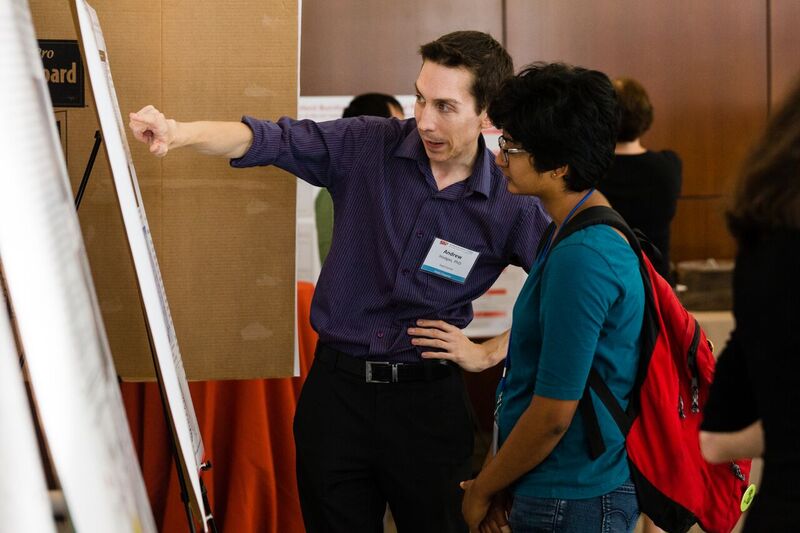
The event closed with a poster session featuring more than 30 presentations by SBP’s best and brightest young scientists. Many congratulations to all that participated in the Symposium, and thanks to the organizers at the Office of Education, Training, & International Services (OETIS) at SBP.

Institute News

Monika Schneider, former SBP postdoc, now a health policy analyst in DC

Authorjmoore
Date

April 26, 2016

This is part of a series on what past SBP postdocs are doing now.

Monika Schneider, PhD, was a postdoctoral researcher in the laboratory of Sumit Chanda, PhD, professor and director of the Immunity and Pathogenesis Program, from 2012-2014, where she studied how the immune system recognizes and clears HIV. After serving as a science policy advocate at the American Association of Immunologists, she recently took a position with the Duke-Margolis Center for Health Policy.

What’s your job like— what do you do every day?

In my current position, I develop policy solutions to issues that affect drug development and health care. My duties include research to identify the main players, current policy, and gaps in knowledge or process; convening meetings with relevant stakeholders; and writing up reports on recommended policies and pathways for implementation.

What do you enjoy most about it and why?

I really enjoy learning new things, and here I get to learn about what has to happen after discovery of a drug at a research institution before it can be marketed. I also get to make an impact on how drug development is prioritized and paid for.

What do you hope to accomplish in your career?

It’s the same as what initially drew me to science in general and immunology in particular: helping to reduce the suffering caused by disease. I hope to develop policies that will result in smarter, faster, and less costly drug development.

What did you gain from your postdoc experience at SBP? 

I really appreciated the translational aspect of much of the research at SBP. I also feel that during my time as a postdoc, I learned how to do team science. Having multiple projects, and collaborators that were on the other side of the country, really strengthened my organizational and project management skills. 

How did you find your first job after your postdoc? Was it challenging?

I found my first job through a job posting site. It was not challenging for me mostly due to good timing and fit—the organization’s leadership knew my references. However, I believe that my involvement in student government and the SBP Science Network (SBP-SN) gave me a leg up.

Were you looking specifically for jobs in science policy?

No, I was also considering scientific program management and medical writing. I really enjoy discussing science (I always liked lab meetings) and technical writing, so I was looking for positions where I could serve as a liaison between scientists and government, business interests, or the public.

What do you miss most and least about San Diego?

I miss the plethora of breweries, Mexican food, and, of course, the friends I made while living there. I do not miss sitting in traffic to get to work (I take the metro now) or the lack of leafy trees and grass.

Institute News

A day in the life of a cancer researcher

AuthorGuest Blogger
Date

October 29, 2015

This story was written by Petrus De Jong, MD, PhD

I hear noise from our boys’ room but decide to check my e-mail first. Waking up in Pacific Time means that e-mails from other time zones are already piling up. Breakfast for everyone and black coffee for me are the next priority.

With the sun roof open, it is only a short commute to Sanford Burnham Prebys. Along the way I pass miles of Pacific coastline, as well as the sites where decades of scientific discoveries have modernized health care. The drive takes less than fifteen minutes, but my personal road to becoming a medical researcher spans almost 15 years. Being part of SBP’s scientific community now, at the frontier of modern medical science, is a real privilege.

While the computer is starting up, I put on my white lab coat to check the cancer cell lines that we have growing for our experimental drug tests. Our lab, led by Prof. Garth Powis, is focused on finding new types of therapeutics for cancer based on unique vulnerabilities of tumor cells. Although it might sound strange, we have to be sure our cancer cells are ‘healthy’ enough for our experiments. We know every detail of their normal shape and growth pattern. I glance through the microscope and know that the cells are good for our next experiment.

lab

Today I am testing the specificity of new drugs that are designed to cut the fuel supply of rapidly growing tumor cells. We can measure whether our new compounds are hitting their target with high precision by using some genetic tricks. If the tricks work, the cancer cells will glow a green color in the dark. I turn off the lights, then turn on the fluorescent laser and look through the microscope. The cells light up in neon green—part one of the experiment worked! The next step is to test whether the drugs have an effect on tumor cell growth.

cancer-cells

Cancer research is teamwork. Today’s experiment was designed based on the work of chemists from Texas (UT Austin), together with protein biologists and medical biologists from SBP. After I put the cells back in the incubator, I grab my notebook and knock on Dr. Powis’ door—even though it’s already open. We have a conference call today with our collaborators to discuss the latest results and future directions. During the technical discussion, I realize that our drug not only has the potential to target and kill cancer cells, but has taught us things we never knew about how normal and tumor cells regulate their energy needs. And this is important, because the more we understand about the fundamental processes that cells use to get energy, the greater the number of opportunities.

Everyone is anxious to hear the results of the next round of experiments and after refueling with a strong espresso, I return to the lab. I am testing two different drugs on the green cells. One of the drugs is bright yellow, the other is colorless. After carefully preparing various drug concentrations, they are added to the cells which then go back into the incubator. It will take 24 hours before I know the results.

I carefully write down the details of today’s experiment in my lab notebook. The remainder of the day is taken up analyzing experimental data, generating figures for publication, preparing for the next lab meeting, sending requests to speakers for upcoming events, and more. Before turning off my computer, I write down my to-do list for tomorrow. I will first check the results from today’s experiment realizing I am not the only one eager to learn about the results.

Finally I hang up my lab coat, hoping to be one step closer to new cures for tomorrow.

Institute News

2014 Fishman Fund Awards announced

Authorrbruni
Date

October 6, 2014

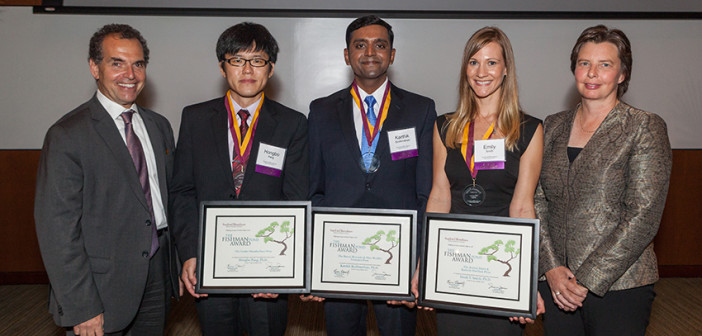
Three gifted and promising young postdoctoral researchers were presented the prestigious Fishman Fund Award at the annual ceremony on October 2. More than 50 generous benefactors and past award winners joined the celebration to congratulate the young scientists and encourage them to continue their research careers. Continue reading “2014 Fishman Fund Awards announced”

Institute News

Meet our Postdocs: Juan Pablo Palavicini

Authorpbartosch
Date

September 4, 2014

This interview with Lake Nona postdoctoral research associate Juan Pablo Palavicini, PhD, is the second installment in our “Meet our Postdocs” Beaker series. Juan Pablo works in the laboratory of Xianlin Han, PhD, which focuses on altered lipid metabolism, trafficking and homeostasis under patho(physio)logical conditions. Continue reading “Meet our Postdocs: Juan Pablo Palavicini”